Showing posts with label travelog. Show all posts

Tuesday, September 12, 2006

Western States Photography Tour: Grand Teton National Park

Fishermen try the Snake River at Schwabacher's Landing.

The view from Signal Mountain in Grand Teton National Park, Wyoming.

I arrived before dawn at the Oxbow Bend viewpoint in Grand Teton National Park. A number of cars were stopped to watch a moose browsing on the side of the road. I pulled over across from him but stayed in the car, as he was not far away. Then he decided that the bushes looked much better on my side fo the road, and he crossed right in front of my parked car! He proceeded to feed on the bushes next to my passenger side window. He looked up briefly as I rolled down the window, then continued on with his business.

After a while he worked his way down towards the Snake River, oining his mate there. I was able to position myself downriver to get the Tetons in the background, just as the day's first light was reaching them.

This is the standard view from the vista point. Not bad, but compare this the following shot, taken from just down the slope!

Getting here requires climbing over the viewpoint retaining wall, and scrambling down a steep path to a small clearing in the trees about 50 feet below the viewpoint. Working a little harder to get just the right angle, you get much more of the river in.

I blew it on the camera settings here, leaving the ISO at 800, which I had used in pre-dawn light. I set the aperture correctly at f/22 for depth of field and the shutter speed ended up being 1/80th sec. Unfortunately there was way too much noise in this shot to have it ever make a good enlargement. This copy of the file is fine since I reduced the resolution about 9X (3x in the vertical and horizontal directions).

If there's another thing that seems a bit different in this view, I rotated the camera to level the plains below the mountains. There are enough off-vertical trees in the foreground to make it plausible, but to me the mountains getting smaller towards the real vanishing point off the left side of the picture seem to provide enough visual clues to give it away, and make the orientation not quite feel right.

The Mormon Row barns are another popular place for dawn shots at Grand Teton National Park.

Saturday, September 09, 2006

Western States Photography Tour: Yellowstone's Norris Geyser Basin, Mammoth Springs, Dunraven Pass

I’m sound asleep in the Norris campground when the alarm signals that it’s time to get up. It’s pitch black outside, which is good since I want to catch sunrise among the steaming thermal features at Norris Geyser Basin. It’s also a positive sign regarding my commitment to photography. There aren’t a lot of things that will rouse me from a perfectly good sleep!

I arrive at the parking lot just as a gray pre-dawn light has arrived. The parking lot is immense, but no one’s there, which isn’t really surprising for dawn in mid September. By the time I reach the first steaming geysers, there’s enough light for some dingy gray shots. A few geysers later, and the sun appears as an orange ball behind the cloudy haze, struggling to clear a nearby ridge and it’s trees. The angle and lighting is awkward, and I snap a couple of shots but they’re not destined to be among the trip’s highlights. I continued around the loop catching a variety of grayish shots, and head back for the parking lot.

There I decide to try the other loop around Black Basin, and I reach it just as the sun is starting to break through a little stronger. Here at least I can offset the fog with the black sand of the basin. People are starting to arrive now, so I can use them as subjects in silhouette. Overall the Norris Geyser basin has some interesting and active features and I’ve started the day with a very pleasant dawn hike, but photographically speaking the sunrise was a non-starter and my second day in Yellowstone is not off to the best of starts. Norris Geyser Basin is simply another area of Yellowstone I’ll have to return to under different conditions.

In the parking lot I comb through maps and photography guides to decide whether I’ll head up towards Mammoth Hot Springs and Gardiner at the North Entrance, or east to Grand Canyon of the Yellowstone. The Mammoth area seems very promising and on the map it appears that partway there is a picnic area near Beaver Lake that could be quite productive as well. The entire back and front cover of the Yellowstone park map consists of a panoramic photo of Minerva Terrace at Mammoth Hot Springs. I decide to head north.

I find a nice reflecting pond along the way and some bison are trotting down the road, but Beaver Lake turns out to be dry. So it’s on to Mammoth. I’m really looking forward to the Mammoth Hot Springs, since I’ve seen some very nice pictures of the bright white and intricately terraced and cascading pools. If the orientation is right, perhaps I can get some nice sunset and sunrise shots there.

When I arrive I see a couple of busses, and I immediately notice a group of passengers wearing clothes that looked like they had been made in the late 1800s. I wondered if perhaps I had stumbled onto a historical reenactment, but as I scanned the other passengers I realized that the ones in handmade clothes were people who simply chose a traditional way of life… like the Amish people that I saw as a child when visiting Pennsylvania, with the possible difference that these folks don’t seem to have any qualms with riding on a bus.

I continued into the Upper Terraces loop road, stopping to hike down and explore the Lower Terrace trails as well. I checked overlook after overlook, walked a lot of boardwalks and climbed a lot of stairs. Most of the lower terrace pools were dry, and bison and elk had trampled many of the delicate travertine structures. I later learned that there had been a drought underway for many years, and that pictures I had seen were most likely from decades earlier when there was far more groundwater coming to the surface. Talk about false advertising! I wondered how many tens of thousands of visitors had driven hours to get to that basin, lured by the colorful post cards and the photo on the Park’s own map, only to be surprised at how few springs and thermal features were actually active there when they arrived.

I ventured briefly out of the park’s north entrance to the rustic town of Gardiner for lunch and to browse for gifts, then returned to the Mammoth Hot Springs Junction to continue my loop towards Tower-Roosevelt Junction and Canyon Village. Shortly after making the turn, slow traffic signals the presence of a herd of elk on the lawns of the church and nearby cabins of this former army post. I find good angles to catch the bull elk in front of the chapel, as if waiting for it to open, and a zoomed shot that compresses him with a camera-wielding tourist behind and a sign that reads “Do Not Approach Wildlife.”.

Continuing on towards Tower-Roosevelt Junction I reach Blacktail ponds, which appear to have good potential for sunrise and sunset reflection shots, but aside from a few coots and ducks paddling around aren’t offering much at the moment. Shortly after the junction I come to 132 foot Tower Falls. It faces east and I’m too late for the morning light, so I decide to press on to reach the Grand Canyon of the Yellowstone before sunset.

There’s one wildlife jam along the way that turns out to be for a cow moose and her calf, but the traffic jams get heavy over Dunraven pass. It turns out that in the fall bears climb the pine trees in search of pine nuts. Most of the bears are high in the trees and obscured by branches, but I find one bear in a smaller, isolated tree, knocking pine cones and entire branches to the ground so he can chew on the pine cones to get at the nuts. He’s only about 50 yards from the road, so it’s easy to set up the tripods and catch him on the ground when he lifts his head above the grass that surrounds the tree. The sun is already behind this ridge and at full zoom my 28-300mm lense opens to only f/5.6, and even boosting the camera's sensitivity to ISO 800 I’m left with a fairly slow 1/50th of a second shutter speed. I’m discovering how much of photography depends upon timing, and how much of timing depends upon luck. While expensive equipment isn’t required to take great pictures and certainly won’t guarantee them, when you come across a bear foraging in low light, it sure would be handy to have a lense with a couple of stops more aperture and light available.

I press on to Canyon Village, and find another cow moose and her calf, feeding in a marshy pond near the road. I find a parking spot in the long line of cars pulled over to the shoulder and add to my new collection of moose shots. The light is fading, and brightest behind the moose. Again low light and low contrast are going to be issues. My family will love the snapshots, but they won’t appear in National Geographic any time soon.

By this time I’ve stopped at enough wildlife jams that the sun has gone down. There’s enough color in the sky that I race to the Artist Point overlook, which appears to have the best orientation for sunset shots at the Grand Canyon of the Yellowstone. By the time I complete the shot hike to the overlook the sunset is gone and I’m left with long exposures of the canyon by the light of the twilight glow.

Getting around Yellowstone has turned out to take longer than expected, even in the off season, thanks to the wildlife and my tendency to get out and photograph it. The weather isn’t expected to improve much over the next few days, so I decide to camp at Lewis Lake and move on to Grand Teton National Park in the morning. I’ll need to return to Yellowstone and hopefully hit more favorable weather, and to allocate more time to cover even short distances while in the park.

Thursday, September 07, 2006

Western States Photography Tour: Across Nevada - A Twisted Tale


"Saigon... shit; I'm still only in Saigon... Every time I think I'm gonna wake up back in the jungle. When I was home after my first tour, it was worse. I'd wake up and there'd be nothing. I hardly said a word to my wife, until I said "yes" to a divorce. When I was here, I wanted to be there; when I was there, all I could think of was getting back into the jungle. I'm here a week now... waiting for a mission... getting softer; every minute I stay in this room, I get weaker, and every minute Charlie squats in the bush, he gets stronger. Each time I looked around, the walls moved in a little tighter."
- Martin Sheen as U.S. Special Forces Captain Willard in Apocalypse Now

Life has a way of sneaking up on you. Job, house, bills, cars, insurance, investments, spouse, anniversaries, vacations, children, birthdays, education, sports, cell phones, email. Complexity tends to increase as the days, weeks, months and years pass. You do what you need to do to get everything done. You set goals, a new car, a second house, and often achieving your goals adds to the pace of your life. The overhead of managing your cumulative belongings, relationships and commitments tends to grow.

In spite of careful planning and steady progress towards your goals, at some point you may sense a subtle disconnect between getting what you want, and wanting what you get. You may notice the gradual erosion of the activities you engaged in and the traditions you practiced, including the ones that contributed to making you who you are, and the ones that soothed your soul.

Every once in a while you have the opportunity to step back, to reassess your goals, your priorities, and the incremental and cumulative effect that they have on your life. You may decide on a change, or some kinds of change may come at you with little warning. Change can be difficult, it can be stressful, but it can also provide the opportunity to adjust the things that you can control - your career, your residence, what you do with your free time - to restore balance. In fact, who you spend time with, including your spouse, is one of the choices you make that can be changed.

Like Captain Willard, I said yes to a divorce. I dream of waking up in a jungle. The temperate jungle of the California redwood forest or the granite towers of Yosemite. The stone jungle of Utah's slot canyons. The intricately layered and wind-carved sandstone of Arizona's buttes and mesas. The blazing aspen of Colorado's high country. When I'm here, I want to be there.

Nevada... shit; I'm still only in Nevada.

Don't get me wrong; I like Nevada. There are some truly beautiful sites in Nevada, but I wouldn't be visiting those on this day. Crossing Nevada can be an exercise, in concentration, in stamina, in your ability to absorb coffee. My crossing consisted of boredom, sparse radio coverage with stations in unfamiliar formats (country, evangelical), and the occassional shock of seeing a tree. Sometimes a live one! It was in this waking stupor that I approached the exit for Deeth, which vaguely struck me as eerily similar to "Death", perhaps spoken in an ancient Celtic dialect.
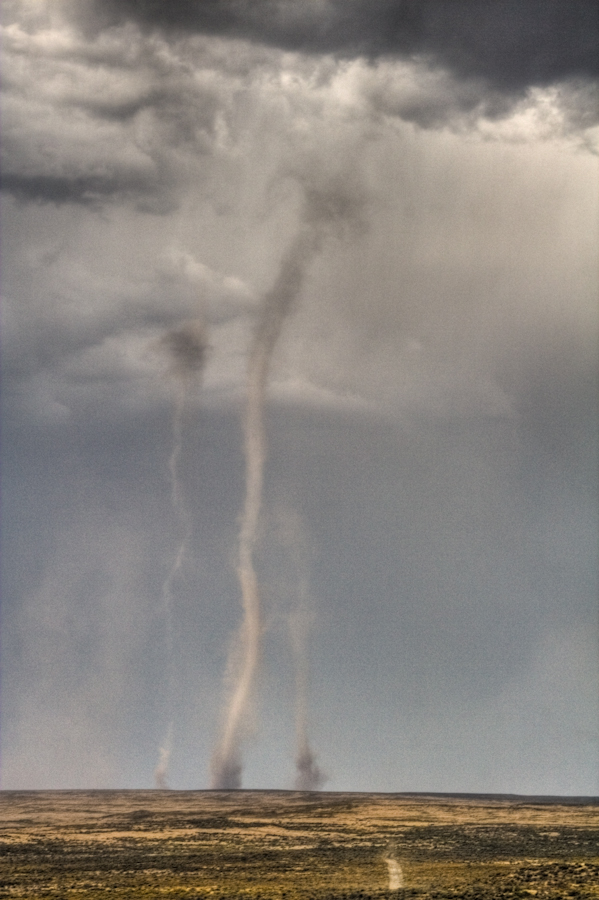
As I scanned the horizon to the north, perhaps scanning for my first tree in over an hour, I could make out a small cloud of dust on a hillside on the horizon. It resembled a column of smoke froma fire... no, perhaps a truck or farm equipment disturbing the dry soil. Over time if grew in size, and I could see by it rotation that it was a "dust devil", a large one. It was growing in size, and another cloud of dust appeared nearby, so I accepted Death's exit and pulled off to watch. The dust in the main column was reaching skyward toward the thunderstorm above, now resembling a true tornado. I was happy not to be in Kansas, where I might actually have something to worry about.

Smaller, tighter columns danced a few hundred yards away. It was still a bit unreal, but it was definitely getting downright interesting. I did what needed to be done: grabbed my camera, snapped my tripod open and locked the legs, clicked the camera in and started shooting. The funnels were highly unstable, appearing in places for a few short minutes, then starting up elsewhere and repeating the process. I counted as many as seven distinct areas where tornadoes were being spawned, with as many as five reaching the ground at any given time.

The front edge of this system was about a mile north of the highway, but it was moving south, in my direction. The leading edge of the rain started to arrive. Things could get too interesting in a hurry. One of those funnels could pop into existence over my head. I did what I could with f-stops and shutter speeds in the dim light, until the wind started howling and debris and rain was flying horizontally past. I could go one more exit to the west and watch this mess from the comfort and safety of my vehicle. I stuffed the camera gear into the front seat just before the deluge hit. I crossed the overpass and accelerated down the ramp, wondering at what point a vehicle starts to develop lift. I left Death behind as fast as I could and pulled off at the next overpass, a mile ro two down the road. I had driven out from under the rain. The funnel clouds were no longer clearly visible in the wall of water now coming down, but there was a large mass of dust mixed in the air that still marked their passing. I had no problems staying awake for the next hour or two, and I had already kicked off my multi-week shooting spree in a very unique way. It seemed to bode well for the trip to come.