Showing posts with label Nevada. Show all posts

Thursday, March 31, 2016

Weather Timelapse: Lenticular Clouds in the Eastern Sierra


A few nights ago I watched lenticular clouds form over the Three Sisters in the Sweetwater Range, across Topaz Lake on the California/Nevada border in the Eastern Sierra. It looked like a little sunset light might get through, so I took a few photographs, and set up my camera to capture a time-lapse sequence of several hundred more, so I could convert them into a video.

As the direct sunlight left the scene and the light faded towards the blue light of twilight, is looked like the cloud cover was too thick, and sunset simply wasn't going to happen.

Then a hint of orange started to appear, and brighten, at the bottom of the stack of clouds.


I reframed the image to capture detail of the evolving light over the Three Sisters.

The sunset light was brief, but intense, and the roughly 1000 photos that I took to capture the moment payed off!

I processed a few hundred of the images into a time-lapse video so you could see the whole event.  Here's the best edit I've produced so far:

Saturday, January 02, 2016

Top 10 Favorite Travel and Landscape Photos from 2015

Bandon Sunset Reflection, Oregon Coast
Ansel Adams once stated that "Twelve significant photographs in any one year is a good crop."  Perhaps Ansel would be more efficient and productive today with digital photography, or perhaps he simply had a really high bar for what he considered "significant".  


I often produce a few dozen photos per year that I'm pleased with and collect into albums on Flickr, so reducing them down further, to something like an annual "Top 10", doesn't always reach the top of my "to do" list. But as the "Photographing California" book that I finished and released in 2015 starts to go into retail auto-pilot, I can take a moment to reflect on my past year of photographic adventures as I look towards 2016. 


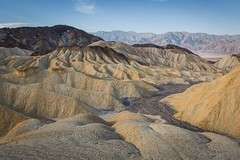
Great Light in Eroded Hills, Eastern Nevada
The photo above was captured early on in my 3500-mile "victory lap" road trip that I embarked on in September, as my book was about to ship to wholesalers and Amazon.com. I visited Mt. Shasta, Lassen Volcanic National Park, and Crater Lake National Park before turning west and heading for the coast. I arrived just in time for sunset. 

In March I took a quick trip across Nevada to scout for locations for possible Nevada photography workshops in 2016. I've been doing this for a few years now, but it takes a lot of experience to get to know a region, in detail, in a variety of season s and weather conditions. The photo to the right shows one of the sites that I really enjoyed for its geology and geometry.  Other sites in Nevada are good for wildflowers, dark, clear night skies, history (petroglyphs, mining areas and abandoned ranches), or cultural details. The state is huge though, and supporting resources such as gas, restaurants and lodging are spread out, so it'll pose some interesting challenges to cover efficiently and comfortably with a group. Access can also be complicated by weather and washouts on the often unpaved roads, so vehicles with appropriate all terrain tires and adequate ground clearance can also be a consideration.


A year wouldn't be complete for me without astrophotography, so in late April I headed out to the Mojave Desert in search of some photos of the Milky Way rising. In the case of the image below, I captured a sequence of 54 photos around 2 am to show the movement of the stars.
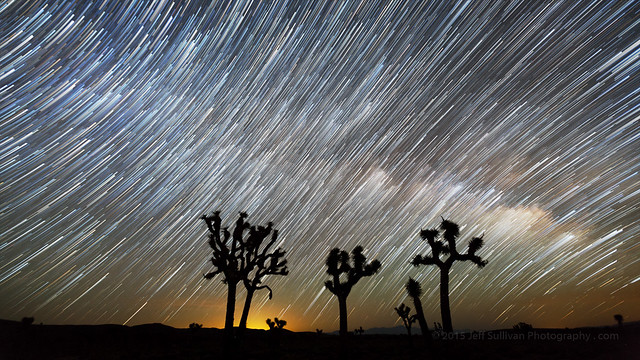

Milky Way Rising Behind Joshua Trees.
Milky Way Rising Behind Joshua Trees, Mojave Desert
In June I still had the Milky Way on my mind, as I dropped by Mono Lake to capture a 360-degree panorama featuring the lake's tufa calcium carbonate rock formations under the arch of the Milky Way.

Mono-Lake-360-degree--panorama-tufa-Milky-Way-night-photography-jeff-sullivan
Mono Lake Milky Way Arch Panorama
By July we had a nice summer monsoon season of sporadic storms, not enough to end our drought in the Eastern Sierra, but storms are certainly a plus for landscape photography! In this case a shaft of golden hour sunlight struck a column of rain, producing a warm-tinted sunset rainbow.

Shaft of Water and Light
Shaft of Water and Light, Topaz Lake
Although there are so many stunning photography locations to cover in California I only included a handful of backpacking destinations in my book, I personally love backpacking, so I took the opportunity to visit the Golden Trout Wilderness in July. Little did I know that the remains of Hurricane Dolores would come ashore that night, creating "super historic" record July rainfall across much of Southern California. Fortunately there was a break in the rain on the following day, so I could head to the trailhead to dry out my gear before selecting my next adventure.

Muir Lake Morning Reflection
Muir Lake Morning Reflection, Golden Trout Wilderness
In August the big event for me is usually the Perseid meteor shower. Sometimes I like to maximize sky in my meteor shower photos, but in this case I decided to include an interesting Joshua tree. So back to the Mojave Desert I went.
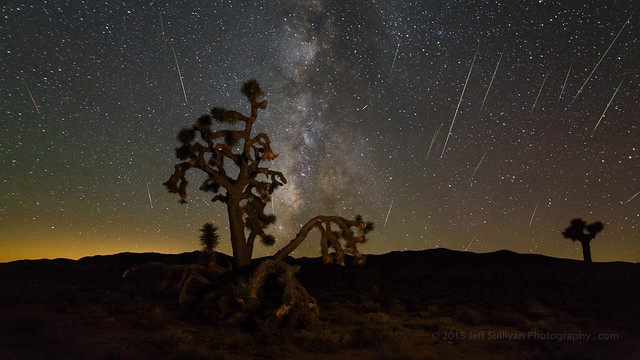
Perseid Meteor Shower 2015
Perseid Meteor Shower and Milky Way over Joshua Tree, Mojave Desert
Another location that I visited during my whirlwind September road trip was Morraine Lake in Alberta's Banff National Park. I was fortunate to arrive right after the first snowfall of the year, and it was still snowing lightly as the last light of the day faded, so there weren't many people out in the cold to wander into this shot along the shoreline. I also picked up the more typical elevated view from a nearby knoll, showing the glacial blue color of the lake, on the following morning.
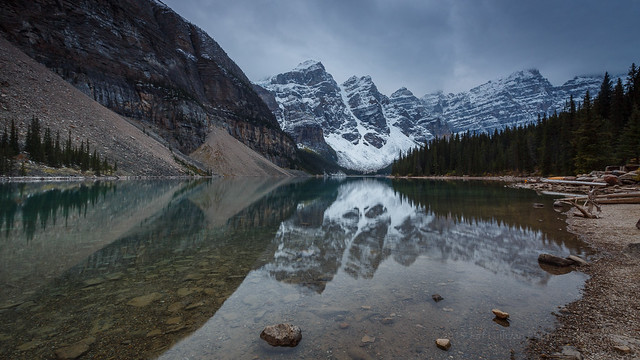
Morraine Lake, Jasper National Park
Morraine Lake, Banff National Park, Alberta, Canada
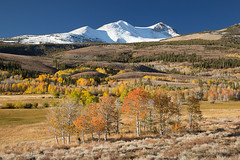
I captured a number of nice Bodie and Eastern Sierra fall colors images this year, but one of my favorites was this late, snowy fall colors shot from Conway Summit in early November. Many of the compositions I was capturing on this morning were a little too evenly lit, but for a moment a thin spot in the cloud cover had the lower portion of this line of trees brightly lit while the trees and hill in the ravine in the background fell into darker shadow. This highlighted the lower line of trees and gave the whole scene a more 3D feel to it.
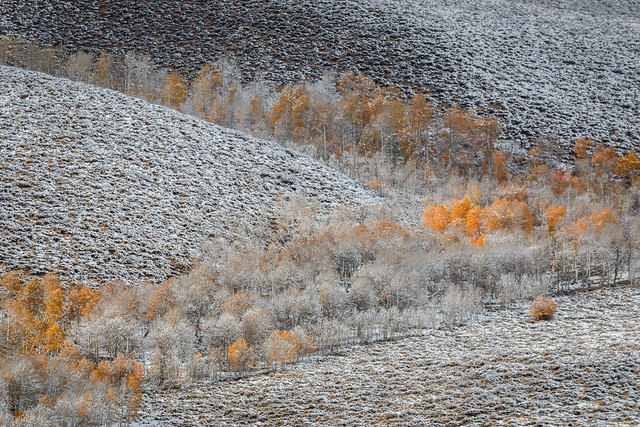
Snowy Fall Aspen
Snowy Fall Aspen, Early November in Mono County
Later in November I headed to Death Valley to pursue some new locations for an upcoming detailed guide to the park that I'm writing, but one of my favorite images ended up being from the Mesquite Flat Dunes near Stovepipe Wells. I had other photos with arguably better light, but the photographers add scale and a nice point of interest. I've photographed these dunes a lot, but the combination of low angle sun and broken light passing through breaks in the clouds created some unique opportunities.
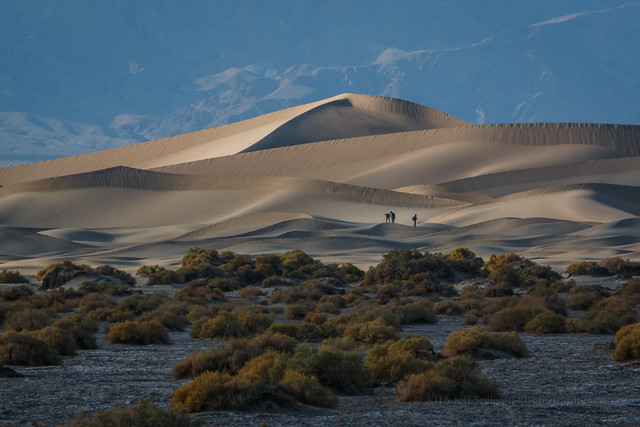

Stunning Light on the Dunes in Death Valley
Exploring the Dunes in Death Valley, Mesquite Flat Sand Dunes
New 2015 Results from Past Years

Valley View Calm Evening Reflection, Aug 2007
As I was working on the book I occasionally came across good photos from past years... when either I lacked the tools to complete a nice result, or I simply overlooked an image due to time constraints or simple oversight. Fortunately I can rediscover and rescue these old files on future visits to the folders that they're in. The one to the right was from Yosemite, way back in August 2007. It was captured on a Canon Digital Rebel XTi! A little adjustment in Lightroom 5, and voila! It's as good as new. I used it as the title page for my guidebook.

One of my more stunning finds was from an incredible sunset in Bodie during one of my workshops on June 29, 2013. Bodie was just outside of the area I was covering with my book, so post-processing photos from there hadn't been a priority. My loss then, and gain now! It was an unusually purple-tinted sunset, as confirmed across many photographers and cameras from various manufacturers.A few shots in the middle of the sunset's transformation had a wide variety of colors, ranging from orange-yellow to magenta-pink and blue to indigo shades, in addition to the base purple that dominated many adjacent shots.
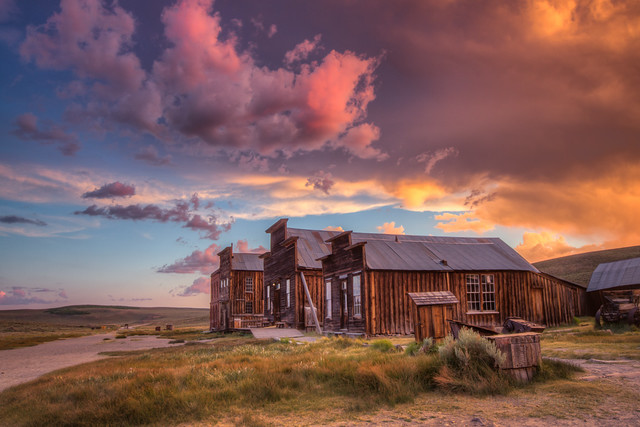
Sunset Over Bodie Main Street
Sunset Over Bodie Main Street, June 2013
There was another surprising overlooked shot that I found in an old Yosemite folder from 2008. Covering Half Dome at sunset from Glacier Point, the Yosemite chapter had already gone through layout before I found it in February, but it's a nice addition to my Yosemite portfolio for future uses!
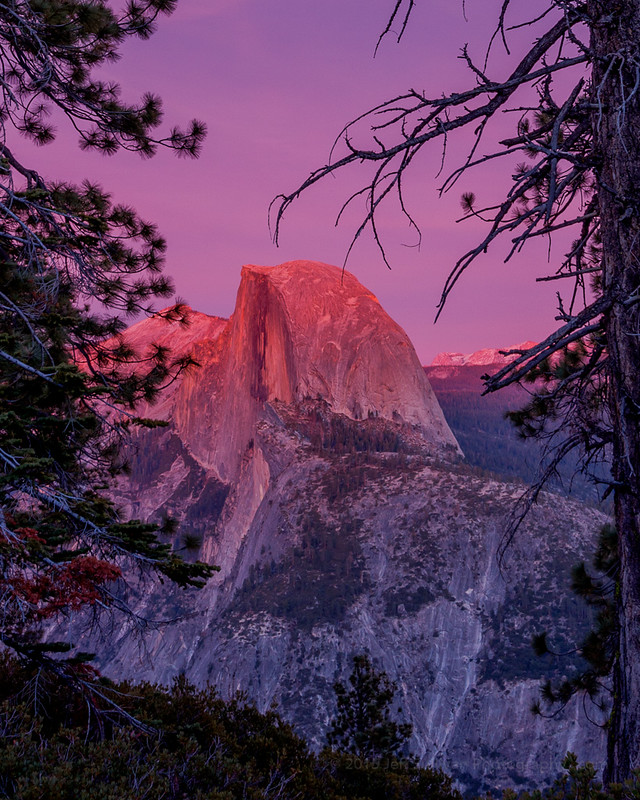
Sunset Alpenglow on Half Dome

Runner-up Images for 2015

I named my Top 10 for people who prefer the predictability and order of a preset and finite number, but I'll show a few of the other contenders for people who prefer not to be arbitrarily constrained.

This sunset shot is from the Cambridge Hills south of Yerington in Mason Valley, Nevada. I was looking for some old cars that were supposed to be in the area, but they were apparently either moved or stolen. The road had to serve as the subject and leading line, heading to that last bit of orange sunlight on a shaft of rain int he distance.

Storm Chasing in Nevada

This dune shot was captured at 200mm to isolate the dune ridge and blowing sand from the dark background. I was hoping to see a desert tortoise or two in the area, but the burrows I found had cobwebs in their entrances.
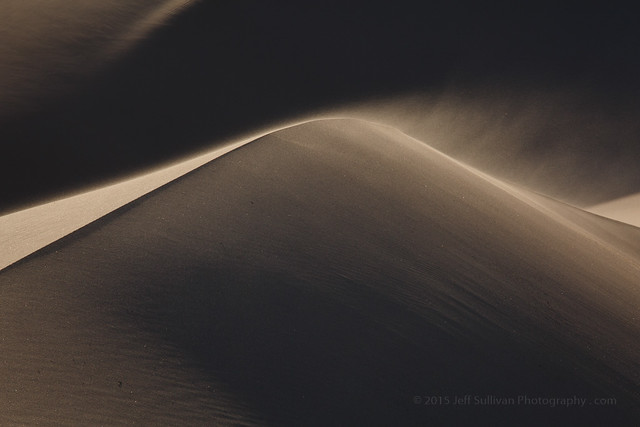
Windy Day on the Dunes in Death Valley

At the bases of Death Valley's mountain ranges, on the edges of their alluvial fans of gravel and debris, you sometimes find small springs. In a landscape that only receives an average of 1.93" of rain per year, these are precious sources of water for nearby wildlife.  They are delicate places as well, with soft mud that will easily become severely trampled if hordes of visitors show up and love them to death.
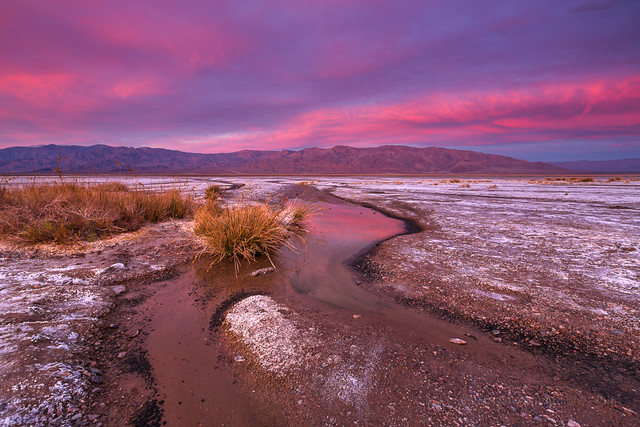
Sunrise in Death Valley

I spend a lot of time in Bodie, and occasionally I'm there for the evening break-up of afternoon thunderstorms. In this case I saw a rainbow forming over town, and I knew that if I shifted my camera position a couple of hundred yards, I could place the rainbow over the Standard Mill. These opportunities can change quickly, so I hopped into my car, and drove east to move the rainbow.
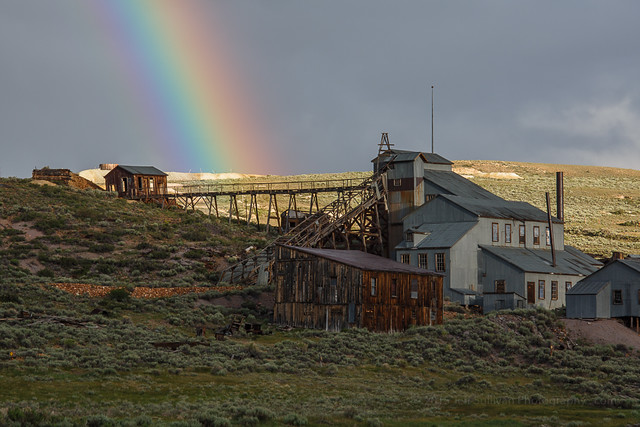
Rainbow over Standard Mill

This rainbow and reflection shot was one of my favorite mobile phone images in 2015, and one of my first photos taken on an LG G4 smartphone that I was provided with as part of the #G4Preview program.
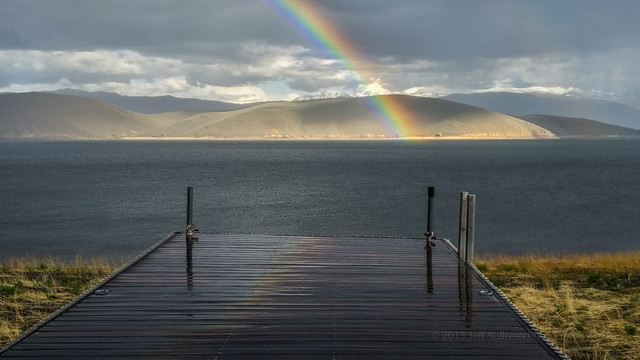
Wet Rainbow Reflection

This sun shot captured through geyser basin fog in Yellowstone is another of my favorite mobile images, this one captured on my 2 year old iPhone 5S.  It won an +Instagram / iPhone assignment being conducted by Outdoor Photographer Magazine.
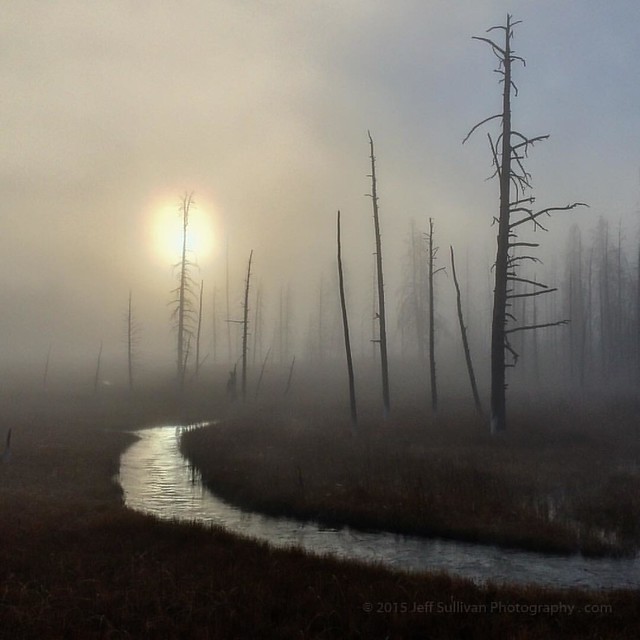
Sun and Trees in Yellowstone Fog

I have many more images that I considered for my favorite photos and moments of 2015, and I've collected over 50 of them in a 2015 Favorites album on Flickr: https://www.flickr.com/photos/jeffreysullivan/albums/72157651316649769

Favorite Photos from Prior Years

Here are some of my collections from prior years.  It has been a great decade of adventure, I can't wait to see what I can find to show you in the next 10!

2014 Favorites album on Flickr
2014 Favorites 

2013 Favorites album on Flickr 

2013 Favorites

2012 Favorites album on Flickr 

2012 Favorites

2011 Favorites album on Flickr
2011 Top 10 blog post

2011 Favorites

2010 Favorites album on Flickr 2010 Top 10 blog post
2010 Favorites

2009 Favorites album on Flickr
2009 Top 10 blog post

2009 Favorites

2008 Favorites album on Flickr 2008 Top 10 blog post
2008 Favorites

2007 Favorites album on Flickr 2007 Top 10 blog post
2007 Favorites

2006 Favorites album on Flickr 2006 Top 10 blog post
2006 Favorites


Thursday, October 22, 2015

Final Leg Home, Without My SUV

Uh oh, "Low Oil Pressure"!
After a breakdown on Friday and a diagnosis by a mobile mechanic on Saturday, it was time to drive from Salt Lake City, Utah back to Topaz Lake, in the Eastern Sierra on the California/Nevada border.  We reserved a rental full size SUV at one agency to fit our gear in, but it was unavailable when we showed up.  They tried to pawn off a RAV4 as full size, then substitute a pickup truck at 2X the price, but we eventually found a minivan elsewhere at a much more reasonable rate.

From our refuge at the Courtyard Marriott near the airport, we were on the highway west in minutes.  Crossing the rest of Utah and all but the last few feet of Nevada would be a trip of over 550 miles, about 8 hours.  First you pass south of the Great Salt Lake.  We had to pull off near a Morton Salt facility due to a very loud whistling sound, caused by the weather stripping on both sides of the minivan windshield.  Copious amounts of gaffers' tape later, the musical vibrating minivan was silenced.

Next you cross the Bonneville Salt Flats, for about an hour.  Near the far end is where the Bonneville Speedway is, where drag races are held, land speed records are broken, and many car commercials are filmed.  This week none of that would be happening, since a heavy rain had left standing water on much of the salt flats, and water-softened rock salt elsewhere.  There were reflections in the water and mirage reflections int he distance, and it was impossible to tell the difference between the two until you were close to the area that you thought had been flooded from a distance.

From the Nevada border to Wells there were some interesting mountains.the Toano Range and the Pequop Mountains. From Wells you can see the colorful aspen-decorated Humboldt Range, where I've camped at Angel Lake in the past.

Immediately after Wells was the exit for Deeth, where I encountered interesting and chaotic weather on a photography trip to the Rocky Mountains in the fall of 2006.

Next you can see the Ruby Mountains, where aspen appeared to be in peak color.  It was tempting to look towards Nevada's best-known leaf-peeping site or Lamoile Canyon and consider the trip out and back from Elko, but the drive today would be long enough without adding side trips to it.
The center of the state tends to be pretty dry and uninhabited, which is either beautiful or barren, or both.  It's not hard to see in the middle of the state how important mining is to the economy, as you pass mining machinery for sale, roads with names like Newmont Mine Road, and the mines themselves, with mountains of tailings growing toward the sky.  The boom and bust cycles as people chase one resource or another also tend to leave some interesting abandoned towns and facilities that can be interesting to explore.

We exited US-80 by Fernley, home to a large Amazon.com warehouse, and continued through Yerington, where we were treated to a moonrise during sunset.  The following evening the moon would rise entering a total eclipse.

The trip started September 7 with Lassen Volcanic National Park, passed through the Olympic Peninsula, to the Canadian Rockies, then down the Rocky Mountains to Grand Teton National Park.  It ended September 26 with the return from Salt lake City.  I was hoping to add a week-long extension to Colorado to enjoy fall colors there, but life is what happens while you're busy making other plans.

Returning early would give me time to prepare for my two-night photography workshop in Bodie State Historic Park.  Besides, if I'd have to be replacing my SUV, I had that unplanned expense to deal with... good thing I didn't have the breakdown another 600 miles further from home.  But if you do take long trips, I can't say enough for roadside assistance plans which give you the protection of a tow up to 200 miles!

I'm going to post the story of this trip on my blogs in installments, in reverse order, so that once they are all posted, they can be read straight through in chronological order to the end, no matter what section new readers may arrive in.  Here's the new post describing the prior day, leading up to the loss of my SUV: http://activesole.blogspot.com/2015/10/end-of-line-explorer-road-trip-September-2015.html

Total lunar eclipse, as seen from home at Topaz Lake on September 27, 2015

Planets, Orionids and Zodiacal Light

Meteor with Venus, Jupiter and Mars rising in zodiacal light during the Orionids, October 22, 2015
Who saw or photographed some Orionid meteors over the last night or two?  In the photo above, a meteor crosses over the path of Venus, Jupiter and Mars, rising in zodiacal light during the Orionid meteor shower around 5 am this morning, October 22, 2015.

Although the streak is clearly a meteor (note the characteristic green color), technically it's not an Orionid, since the radiant point for the Orionid meteor shower is out of the upper right corner of the frame.  So this meteor is traveling at nearly a right angle to what its trajectory would be if it were one of the Orionids.

It may however be a Leo Minorid meteor, since its radiant point is to the left of Venus Jupiter and Mars this morning.  The Leo Minorid meteor shower peaks the morning of October 23, but it is a minor shower with an estimated 2 meteors per hour, but minor showers sometimes have an unexpectedly high rate, so tomorrow morning could offer a surprise from the Leo Minorids along with after-peak Orionids.

There are also random, sporadic meteors, particularly in the early morning, as your position on the earth rotates to the leading side of the earth as it travels through space rotating around the sun.

The Zodiacal light is sunlight shining off of dust in our solar system, the light tilted up from the lower left in the photo above.  You can experience the Zodiacal light, or false dawn, this time of year when a a pyramid-shaped glow can be seen in the east an hour before dawn's first light (or 80 to 120 minutes before sunrise). This light is caused by sunlight reflecting off of dust particles in space in the same plane as earth and can resemble the lights from a city. It is tilted to follow the same ecliptic plane that the planets travel in.  Zodiacal light is best seen under dark skies, in places with minimal light pollution.  You can catch the Zodiacal light for another 2 or 3 mornings this month, but after that the moon will be too full and it will no longer set early enough to leave you with a dark enough sky to see this pre-dawn light.

You can see the Zodiacal light as the planets rise in this time-lapse video captured this morning before and twilight light started to brighten the sky:


Venus, Jupiter and Mars in Zodiacal light during the Orionid meteor shower this morning


Wednesday, May 20, 2015

At the End of the Rainbow: More LG G4 Sample Photos

Sample image from the new LG G4, captured in RAW (DNG format) and converted to JPG
LG G4 in Panorama mode
The rain and rainbows at Topaz Lake last night kept coming and going, so you had to move fast to catch them.  The rainbow arrived just as I was pulling steaks off of the grill, so in between bites of dinner I was in and out of the house with various cameras as the rainbows came and went.

When it reached more or less complete double rainbow stage, they spanned the California / Nevada border, so both states had a pot of gold waiting.  The rainbow was too tall to catch in a single photo so I put the LG G4 phone I'm evaluating into panorama mode to capture a wider field of view both vertically and horizontally.  Most of the time I was out with that as my camera for convenience, as it was easier to shield from the rain.

As the sun set, the sunlight moved higher and the rainbow lifted off the water of the lake.  For a brief while the small patch of remaining spectral color added extra bands of purple and green, a rare "supernumerary" rainbow!

As the patch of light became smaller and smaller, I pulled out a Canon 5D Mark III with 70 - 200mm lens to get high resolution at high zoom.  There's still a solid place for the extra pounds and dollars of equipment for some applications, even as smartphone cameras rise in capability and the DSLR niche in the camera market becomes a smaller piece of a much larger whole.

LG G4 in HDR mode
I find that I don't take fewer DSLR photos as mobile phones get better, I just take more photos overall as mobile phones provide immediate "in your pocket" convenience, connectivity to social media, panorama capability, solid close-up performance without switching lenses, and access to a massive app ecosystem.  I also have to admit to liking the convenience of never having to clean dust spots off of the images from a mobile phone camera.  DLSR manufacturers should be looking at all of this, including cultivating an app ecosystem both on the control/exposure side and on the editing/filter/post-processing side.  Until they get there, my phone will take the photo more and more often, no matter how much I love my DSLRs.

LG G4 in HDR mode
The image at the top above was captured in RAW format on the LG G4.  Shooting in RAW also results in a JPG version being saved as well, so you can use the image immediately in that format.  The RAW file was 19,559 MB, the JPG was 6,820 MB, so you can get a sense of how much more the RAW file gives you to work with if you might want to do a fair amount of adjustment later.

But the advantages of RAW go beyond color/information depth.  You have more control over how much JPG compression is applied, sharpening, noise reduction, and other things which affect the resulting quality.  You can see that inspecting the high resolution samples I provided with a blog post a couple of days ago (they should expand as you click on them, although I haven't tested that in various browsers):

New LG G4 Smartphone Review: Raw File Output!
http://activesole.blogspot.com/2015/05/new-lg-g4-smartphone-raw-file-review.html

The difference isn't great for most uses and print sizes, but if you're in a stunning moment and might want to blow the result up really large, RAW is the way to go.

Disclosure: I should mention that the LG G4 was supplied to me as part of the effort to raise awareness of the #G4Preview Tour underway via +T Mobile vans across the United States this month.  The phone couldn't have come at a better time for me, since I've been wanting a larger format phone for some time (especially one with manual camera control and RAW output), but I've been locked into a 2-year upgrade cycle, which doesn't come up for renewal until November.  My commitment to mention the tour was met a couple of days ago, but in the interest of full disclosure I'll mention that the phone was supplied to me for a while longer, until it's clear (and bordering on rudely tedious) on my various social media accounts.

Tuesday, May 19, 2015

Storm Chasing in Nevada

Sunset storm over the Cambridge Hills in Lyon County, Nevada
Smith Valley south of Wellington
At Topaz Lake on the California/Nevada border,  and I had a storm pass by earlier this month.  There was lighting over by Wellington in Smith Valley, so we decided to chase it east into Smith Valley to see if we could catch some lightning photos. 


We saw some flashes of lightning in the distance, but it was way ahead of us.  We didn't catch the storm in Smith Valley; it continued over the next set of mountains to Mason Valley, south of Yerington.


So we headed through Wilson Canyon and once in Mason Valley headed south, ending up in the Cambridge Hills as the skies cleared towards the setting sun, and "golden hour" color spread under the storm clouds. 

Crepuscular rays, sun rays, were streaming down past the clouds.  I had to pull over to catch a quick hand-held picture.

The storm was to the west, the sun was shining under it from the east, and we were under the edge, which ran north and south.


I continued on to where I knew there was an old stone building in the Cambridge Hills mining district that could serve as s good foreground subject.  The light was perfect with a dark, shadowy hill in the middle and the clouds breaking up, revealing a mountain in the distance.

We headed west over the hills, but the country was opening up and there would be few foreground subjects, so we backtracked briefly to shoot toward the sun.  We turned north on a two track side road through the sagebrush, and at some point had to simply stop and make do with whatever foregrounds we could compose, as the light was going off, and it would't last.


We had some great opportunities as the sun went from yellow to orange and shot light under the storm clouds, while the clouds to the east of us started to take on shades at the blue end of the spectrum (above).  

When you mix cool and warm tones, blue cloud-diffused light with orange to red sunset tones, you can get shares of purple, pink and magenta.  Some people don't believe that those tones happen in the sky in real life, but there they were, and they were consistently captured across multiple cameras.  


When the best of the color was past, and the sky darkened and faded a bit, I could  slow down, start to put away my DSLR, and see what  smartphone could do with what was left.  A panorama seemed appropriate to show the transition into the darkness under the storm.


We stuck around to capture a time-lapse of the clouds moving as the storm dissipated, and as the nearly-full moon rose behind them.

We never did catch up to the storm of capture any lightning shots, but we sure found some great conditions that we never could have anticipated!  Sometimes showing up is what it takes to see the amazing things that happen all around us every day. 

Last golden hour light before the sky went crazy.