Tuesday, October 20, 2009

Orionid Meteor Shower Tonight (October 20/21)!

Here's an article for more information:
news.yahoo.com/s/space/20091020/sc_space/getoutorionidmet...
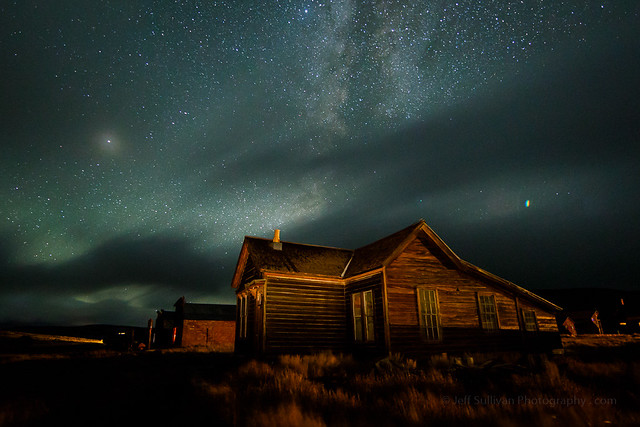
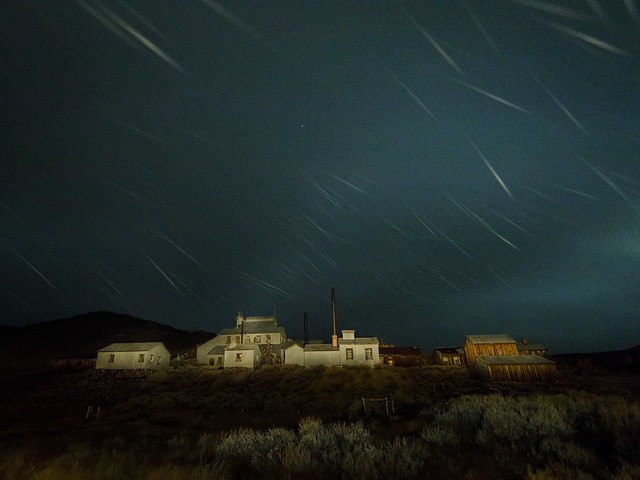
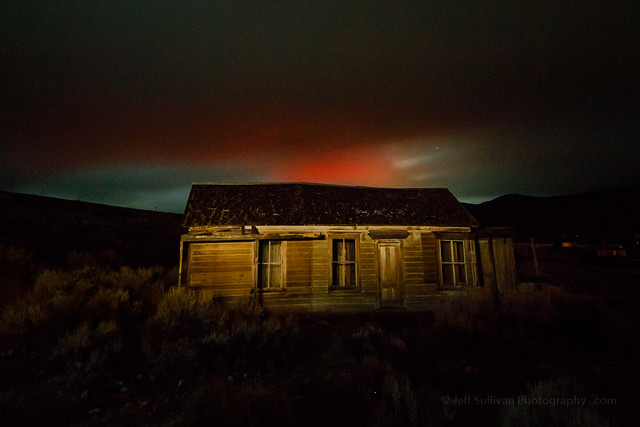
The Orionid meteor shower is expected to put on a good show tonight into the predawn hours Wednesday, weather permitting.

This annual meteor shower is created when Earth passes through trails of comet debris left in space long ago by Halley's Comet. The "shooting stars" develop when bits typically no larger than a pea , and mostly sand-grain-sized, vaporize in Earth's upper atmosphere.

"Flakes of comet dust hitting the atmosphere should give us dozens of meteors per hour," said Bill Cooke of NASA's Meteoroid Environment Office.

My Interview in Photographer Magazine

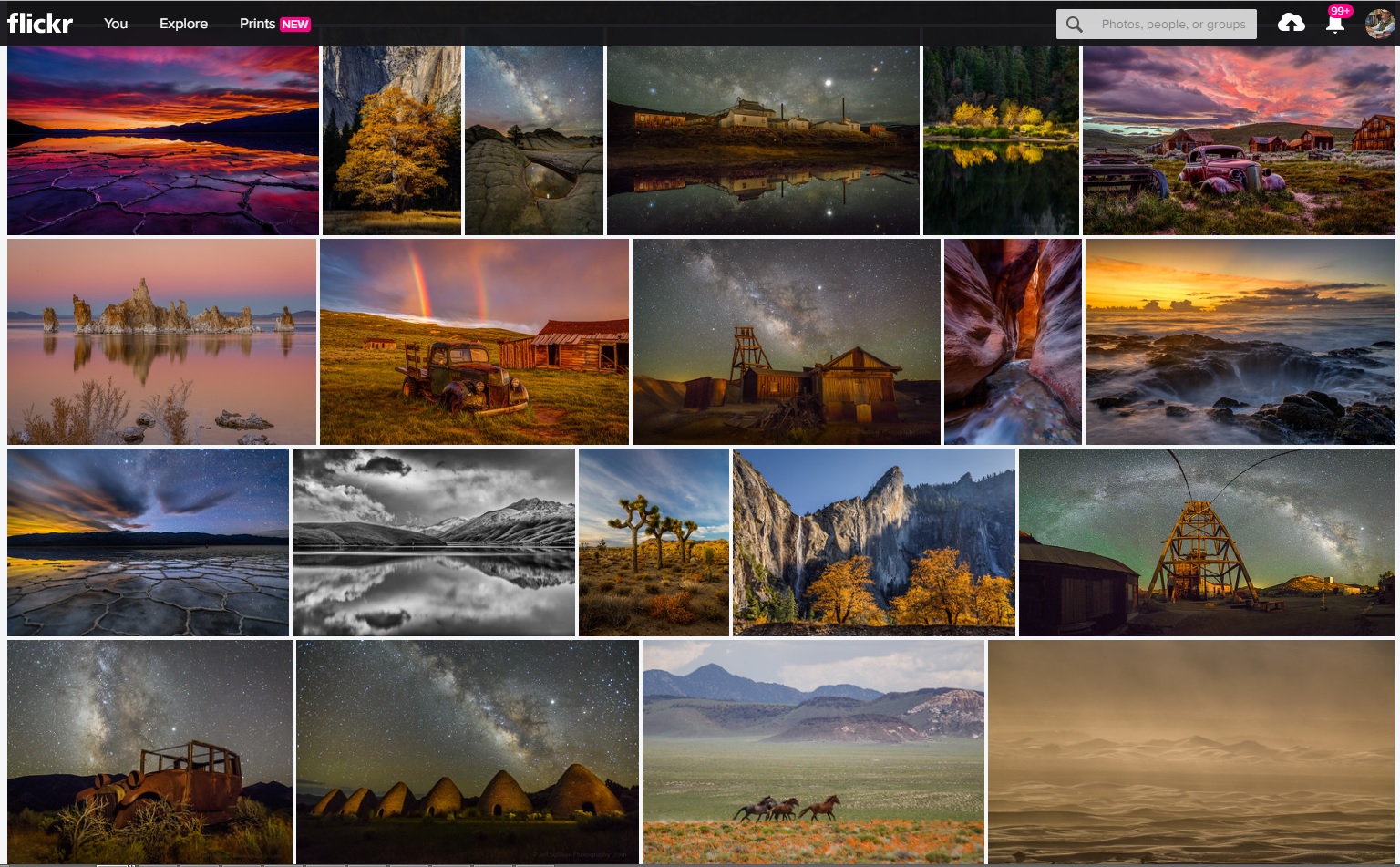
I can't read it, but it looks cool! Click on the photo to go see more pics from the article on Flickr...

Thursday, October 15, 2009

Free Business Card Offer from MOO

How do they turn out? Judge for yourself... mine just arrived. Double sided, high resolution, matte finish, printed on heavy cardstock, what's not to like? The only flaw is the slight white margin at the top of the photo on the contact info side.

In case you missed my notices regarding this offer on Flickr, Facebook, and Twitter (JeffSull), here's where you can get your 50 free trial business cards available here from MOO for the first 10,000 Flickr users: www.moo.com/en/partner/flickr-business-cards

Wednesday, October 14, 2009

Upcoming Meteor Showers for Fall 2009

As you plan where and when you might want to get out and shoot during the rest of 2009, consider the following meteor showers coming up:
Orionid - Oct 20-22
"October's new Moon also perfectly favours the Orionids at their peak in 2009. The shower's radiant, near the celestial equator, is at a useful elevation by around local midnight in either hemisphere, somewhat before in the north, so most of the world can enjoy the shower."
Northern Taurids - Nov 12
"The NTA peak has only a waning crescent Moon, however. With near-ecliptic radiants, all meteoricists can observe these streams, albeit northern hemisphere observers are somewhat better-placed, as here suitable radiant zenith distances persist for much of the night, though from the southern hemisphere, a good 3-5 hours' watching around local midnight is possible with Taurus well above the horizon."
Leonid - Nov 17
"Luckily, new Moon on November 16 ensures perfectly dark skies for covering whatever events happen"
"the 21h-22h UT apparently critical interval will fall best chiefly for sites across Asia, from the extreme east of Europe eastwards to Japan and places at similar longitudes, but with the possibility of some unusual activity at almost any stage from ~ 6h-24h UT on November 17, only European and African longitudes look set to miss out."
Geminid - Dec 13/14
"One of the finest, and probably the most reliable, of the major annual showers presently observable, whose peak this year is virtually coincident with new Moon."
More information:
skytour.homestead.com/met2009.html
www.imo.net/calendar/2009#nta

The Tuarids will peak on November 12 during the photography workshop that I'll be conducting in Arches and Canyonlands National Parks Nov 11-14:
www.MountainHighWorkshops.com

Hope you can join us!

Thursday, October 08, 2009

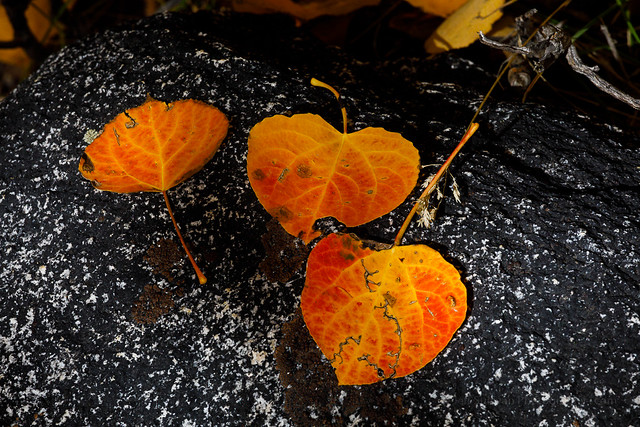
Fall Isn't Just Colorful Leaves


I've decided not to upload most of these photos to Flickr. The site is simply too delicate to risk having people find it and trample it into oblivion!


Sunday, October 04, 2009

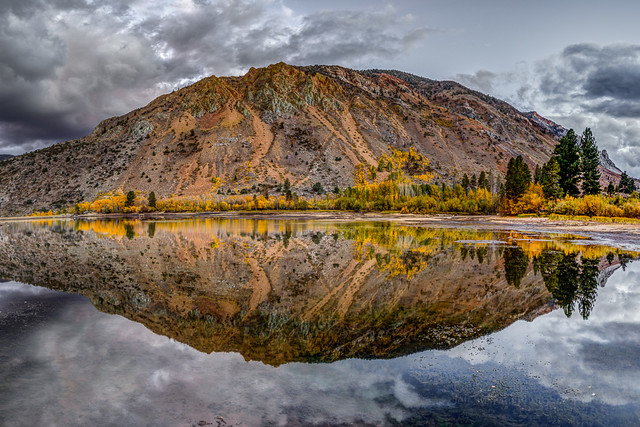
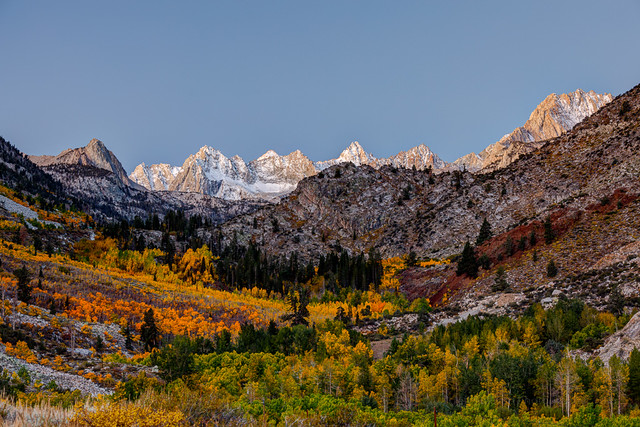
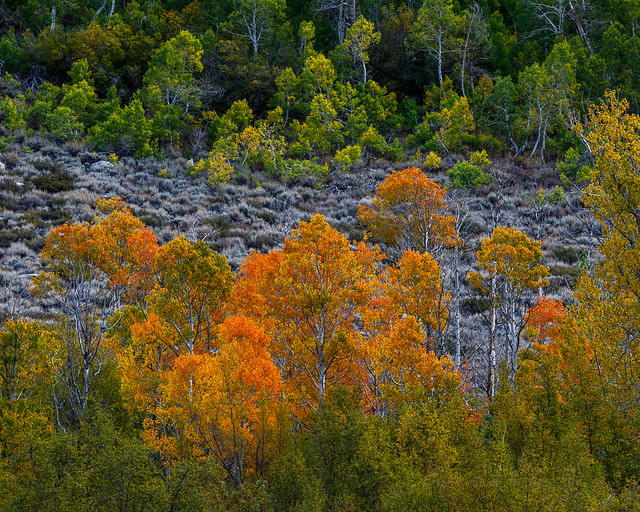
Fall Colors in the Eastern Sierra

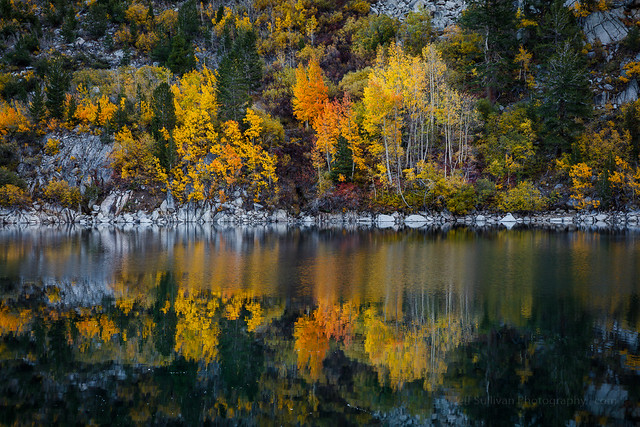
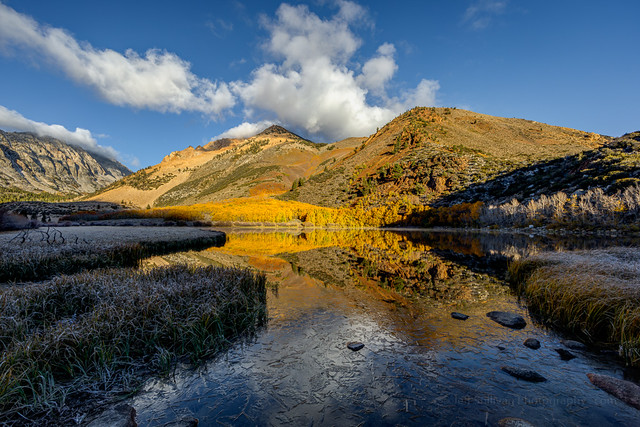
I arrived at North Lake October 1, only to discover that I missed the peak color by a day or two due to a wind storm that blew off the best red to yellow colors on the far hillside. The color present a few days ago seems to have partially blown off the trees, partially turned towards brown, but there were still some green leaves, leaving the possibility of more color in a few days.

You can find decent color in patches if you look hard enough, but the best color might not be until more of the green starts to change at lower elevations, perhaps late next week?

By the time I returned here Sunday morning, there was about 2-3" of snow by the lake. The same thing happened last year, a dusting of snow around the end of September, early October. It was a little heavier this time, and there were prints from a dozen horses and mules as the packer started in around dawn to rescue their customers from the likely 4-6" of snow higher up. There were about 6-8 snow-covered cars in the parking lot by the pack station, people off in the backcountry, most likely experiencing heavier snow. I'd like to see their pictures!


Wednesday, September 30, 2009

Fall Workshop Schedule (Updated 9/30)

I'm constantly tuning details on my Fall schedule, but here are examples of some of the workshop destinations that I'm considering:

Oct 31-Nov 1 Fall in Yosemite Valley
Nov 7-8 Fall in Zion National Park and vicinity
Nov 11-14 Arches/Canyonlands/Moab, Utah
Nov 28 Yosemite: Moon Over Half Dome
Feb 2010 Horsetail Falls at Sunset and Yosemite Valley in Winter

The Nov 11-14 Arches/Canyonlands trip is described in more detail here: www.MountainHighWorkshops.com
It's a repeat of our instructor lineup from Mammoth/Mono workshop in June which we received rave reviews on.

Contact me for pricing and other details, or to discuss the possibility of different locations or dates.

Tuesday, September 29, 2009

Watch the National Parks Special Every Night This Week!

FYI, a treat for anyone who enjoys America's national parks:
THE NATIONAL PARKS: AMERICA'S BEST IDEA by Ken Burns

Check this link for times and channels in your area:
www.pbs.org/nationalparks/tv-schedules/
Even if you missed the first episode Sunday night (Yosemite, Yellowstone, John Muir, etc.), each episode is repeated later in the week (check the schedule for details).


Here are sample showing times that I looked up for DirecTV on the West Coast:

Monday, September 28 — 08:00pm
0006 - KVIE
The Last Refuge (1890-1915)
The years 1890 to 1915, when many Americans feared industrialization would negatively impact the country's pristine lands, are recalled. With Congress yet to establish authority or appropriations for park protection, a conservation movement begins.
duration: 150 min
details: [HD] | [cc] [stereo] [ed taping rights: 1 year]

Tuesday, September 29 — 04:00am
0006 - KVIE
The Scripture of Nature (1851-1890) (repeat of Sunday's premiere)
The sumptuously filmed history of America's national parks begins in 1851, when California's beautiful Yosemite Valley started to attract people who wished to exploit the land, and others, like John Muir, who believed it should be preserved.
duration: 120 min
details: [HD] | [cc] [stereo] [ed taping rights: 1 year]

Tuesday, September 29 — 08:00pm
0006 - KVIE
The Empire of Grandeur (1915-1919)
The years 1915-19, when the conservation movement successfully pressured the federal government to create the National Park Service to oversee the nation's national parks, are recalled.
duration: 120 min
details: [HD] | [cc] [stereo] [ed taping rights: 1 year]

Wednesday, September 30 — 08:00pm
0006 - KVIE
Going Home (1920-1933)
The years 1920-33, when the automobile enabled more people to visit the national parks, are recalled. Included: National Park Service director Stephen Mather pushes to build more roads in the parks.
duration: 120 min
details: [HD] | [cc] [stereo] [ed taping rights: 1 year]

Thursday, October 01 — 08:00pm
0922 - KVIE
Great Nature (1933-1945)
The years 1933-45 are recalled. Included: the Civilian Conservation Corps are created during the Depression to undertake renovation projects in the national parks; NPS biologist George Melendez Wright pushes to reform the NPS's wildlife policies.
duration: 120 min
details: [HD] | [cc] [stereo] [ed taping rights: 1 year]

Friday, October 02 — 08:00pm
0006 - KVIE
The Morning of Creation (1946-1980)
The series finale covers the years 1946-80. Following World War II, the parks see a dramatic increase in visitors, resulting in a billion-dollar campaign to improve facilities and infrastructure.
duration: 120 min
details: [HD] | [cc] [stereo] [ed taping rights: 1 year]

Monday, September 28, 2009

UT/AZ: Hike to the Wave

"The Wave" in the Coyote Buttes near Page, Arizona. To get one of the 10 next day permits to hike here, I had to enter the daily 9am drawing on two consecutive days. On those days, 67 and 63 people showed up hoping to obtain a permit. On the second day they give you two chances, on the third day they give you three chances.


UT/AZ: Hike to Wahweap Hoodoos

Light painting in southern Utah. The yellow was painted with a headlamp using an incandescent bulb, and the blue one was painted with an LED headlamp.


Trip to UT/AZ: Antelope Canyon

Antelope Canyon near Page, Arizona. I'd like to take some people around this area in early November.


Quick Trip to UT/AZ: Hike to The Subway

"The Subway" in Zion National Park, Utah. The sun was mostly behind clouds, so I didn't have the reflected red light from the opposing sandstone cliffs coming in the other end this time.

After a few test shots, I set my aperture down to f/22 and my ISO to "L" (50) so I could use a long exposure of 30 seconds to capture the trails of the leaves moving around in the pool. Before I print this, I should still go back and see if i can increase contrast on those leaves so they show up better.


Quick Trip to Utah & Arizona: Valley of Fire

An overnight stop and morning shoot near Las Vegas, Nevada.


Wednesday, September 09, 2009

My Photography in the Second Saturday Art Walk This Saturday


VOX Sept flyer, originally uploaded by jillallyn.

I'll be joining approximately 25 photographers from the Sacramento area this Saturday to display my works during the Second Saturday Art Walk in downtown Sacramento.

If you haven't been to the Second Saturday Art Walk, it's a fun event with all kinds of art, and many galleries have musicians playing and serve hors d'œuvres. Other businesses open for business during the event as well. one of my favorite stops the last time I attended was a winery that has established itself downtown.

The gallery will be open on Saturday night from approximately 6-10pm. I'll try to be there from 6-7pm or so. Come on down to 1931 H Street and say "Hi"!

For a map to the VOX Sacramento gallery, visit their Web page: www.voxsac.com/

Monday, September 07, 2009

Day 7: Sunday and Last Night at Burning Man 2009

Sunday at Burning Man is the day when the massive wooden "temple" is burned. I rrived early to get a decent view, and used a slow shutter speed to blur the procession of people walking in front of me.

Fire of Fires by David Umlas, Marrilee Ratcliffe, Community Art Makers:
earth.burningman.com/brc/2009/art_installation/430/


Sunday, September 06, 2009

Day 6: The Wind Continues and The Man Burns, Saturday

After shooting things and people for several days, it was comforting to find a shot that felt more like a desert landscape. The Black Rock Desert has the ability to heal itself quickly of the footprints left the night before.

Unfortunately my tent was completely flattened by the wind on Friday afternoon, and upon returning late at night and finding the wind velocity still high, I didn't have the energy to try to plant some stakes upwind and tie it down to see if it might stay up. I slept on the platform taht I've built in the back of my (by now very dusty) minivan.


Saturday, September 05, 2009

Day 5: Burning Man 2009, Venturing Out by Day

You never know what you're going to run across at Burning Man! I ofund this guy standing under the Soma art installtion by Flaming Lotus Girls. He was standing completely still, shooting a timelapse sequence for some reason. I'll try to follow up and find out why!

Soma, by Flaming Lotus Girls:
earth.burningman.com/brc/2009/art_installation/439/


Friday night featured the "launch" of the Raygun Gothic Rocket Ship. I sat for hours waiting to see if the event would occur in the high winds, but I ran out of patience in the dust and wind and headed back to camp.

Friday, September 04, 2009

Day 4: Thursday at Black Rock City, Burning Man 2009

Groovik's Cube by Barry Brummitt
URL: www.groovik.com/
http://earth.burningman.com/brc/2009/art_installation/471/


Thursday, September 03, 2009

Day 3: Wednesday at Burning Man 2009

A performer spits fire on the Towers of Shiva stage at Burning Man 2009. Here's the Burning Man Earth entry for that art installation:
http://earth.burningman.com/brc/art_installation/445/

I really like the abstract quality of this shot.


Wednesday, September 02, 2009

Burning Man Day 2: Tuesday in the Black Rock Desert

The art installation Portal of Evolution as the sun prepares to set at Burning Man 2009. Here's the Burning Man Earth entry for that art piece:
http://earth.burningman.com/brc/art_installation/437/


Tuesday, September 01, 2009

Burning Man 2009: Monday August 31

Just a quick note to say that I've started uploading photos and videos from Burning Man 2009 to my Flickr photostream:
http://www.flickr.com/photos/jeffreysullivan/

I'll post some of the best here as I get more edited!


Wednesday, August 26, 2009

Perseid Meteor Shower III HD Video

This is my third and longest timelapse sequence yet from the Perseid Meteor Shower in August. I'll try to have sequences four and five done soon.

Make sure you have the HD display switched on (click on the HD symbol).

One of my first videos of this event was featured on Discover Magazine's blog.

Bear in mind that this is a timelapse video, so in playback as video everything is dramatically sped up. Each frame is a 15 to 30 second shot, but the video is assembled at a relatively slow frame rate of only 12 shots per second, so in video formats that play at 24 to 30 frames per second, the meteors show up for roughly two frames. In other words, each second of video displays ten to twenty minutes of shooting time. Apparently our eyes and minds are quick enough for us to perceive the meteors with some persistence even though they show up for only 1/12th of a second.

Anything that travels across the screen or survives in the video for more than a brief flash is a jet or satellite (and you can't see many of the meteors in most online copies of the video, unless you follow the links to Flickr and enable the highest HD playback available there). I'll try to find video hosting sites that enable blogging of copies that offer higher resolution playback, preferably full 1920 x 1080 HD. I'll also try to find some nice background music avalable under the Creative Commons CC-BY license (which does not seem to be a trivial search).

Meanwhile, if you'd like to explore timelapse photography yourself, download the free VirtualDub software which can convert a sequence of JPEG files into video, and check out the forum on Timescapes.org for discussions on techniques. You'll need a tripod of course, and your sequence of still images will turn out best if you use a remote switch that has an intervalometer (timer) function.

Perseid Meteors Near Tioga Pass: HD Video Timelapse II

To avoid smoke from forest fires in California I traveled to this location at an elevation of 10,000 feet near Tioga Pass in the Sierra Nevada.

To increase the visibility of the meteors, click through to the video's Flickr page and make sure you have the HD display switched on (click on the HD symbol). Then look near the center of the right half of the video to see the most meteors.

This sequence was assembled from 517 21 megapixel photos. The rescaling down to 1280 x 720 for uploading to Flickr helps eliminate much of the noise. The photos on this night were exposed for 10 to 20 seconds at an ISO sensitivity of 3200.

This was taken on the peak night for the meteor showers, but the moon makes all but the brightest meteors difficult to see, especially at these lower resolutions.

Friday, August 21, 2009

Perseid Meteor Shower HD Video

Dozens of Perseid meteors fall in the course of over one hour, compressed into 5 seconds of HD video.

Go to my Flickr account and set the "HD" symbol under the display to see a higher resolution online.

Copyright © Jeff Sullivan 2009. All rights reserved. Do not copy or publish without permission.

Tuesday, August 18, 2009

What Camera Do You Use? What Camera Should I Buy?

I have these questions asked to me. A lot.

What paper does J.K. Rowling write on to create the Harry Potter series? What typewriter did Hunter S. Thompson use? What species of quill and what formulation of ink did John Muir and Henry David Thoreau use? If only I could have the same advantages that they had!


To make a long story short, in tests performed years ago neither professional photographers nor amateurs could distinguish between 5 megapixel and 8 megapixel shots when printed at 8" x 10" size. The industry's dirty little secret is that new cameras have are overkill for almost all photographers, and they have been for years. If you're not taking the pictures that you want, it's probably your expectations and your process that needs adjustment, not your equipment. In other words, the camera is not your most important consideration, nor is it your most important tool. You'll find that between your ears. At least I hope so. (And now that I've saved you $500-5000 in hardware upgrades, you send me my commission for that gain via Paypal.)

Now I'm going to contradict myself and give a few exceptions. First and most obviously, if you want to print a lot of photos in sizes of 40" or larger, a little more resolution than 5-8MP might help (although my 8MP files print well up to 20" x 30").

Next, I can vouch for the fact that high ISO shooting capability is one of the most important improvements that DSLRs have added in recent years, for handheld use in low light (portraits, weddings, concerts, fireworks, Chinese New Year Parade, etc.), night landscape shots (see my new night shot gallery and recent Milky Way shots on Flickr) and so on. Specifically, a friend asked me about the Canon Digital Rebel T1i/500D, and the reviews on sites such as Steve's Digicams verify that it delivers well on its promise for high ISO shooting.

If the Canon T1i had the 40D's 6.5 fps for sports (kids sports, skiing, etc.) and full 1080 resolution HD at a full 24 frames per second it would be perfect. Perhaps there will be a "60D" update to the 50D which adds these features. There's a show in September where new models are often introduced, and if we're lucky, the 50D replacement could be shipping by Fall.

In the meantime, the Canon T1i is a reasonable upgrade for indoor, sports and outdoor low light shooting.

Whatever you do, consider setting aside some budget for the Canon TC-80N3 Remote Timer Switch, which will allow you to do time lapse photography (including of the earth rotating under stars at night with high ISO shooting). There are a number of programs that will enable you to combine a series of downsized JPG still frames to make an HD movie. One nice benefit is that you can run the individial frames through a batch editing program like Adobe Lightroom so you can efficiently do a ton of edits and enhancements and have the video turn out with stunning quality.

Thursday, August 13, 2009

Bug on the Earth's Windshield

While hurling through space, the earth slams into a piece of debris from the Comet Swift-Tuttle (top right) during the annual Perseid Meteor Shower, as an orange moon rises through smoke from California's forest fires to shine on the Ancient Bristlecone Pine Forest at an elevation of 10,000 feet in the White Mountains.


One theory behind how life could spread among the stars is that amino acids could arrive on comets and survive the impact. It seems fitting to be among earth's oldest living things to witness comet debris falling to earth under the light of our neighboring stars.

Wednesday, August 12, 2009

Perseid Meteor Over the High Sierra

If you can find a patch of sky with minimal light pollution, the peak showers happening midnight to 5am tonight (Wed), and they'll continue at a declining rate for a few more days. The meteors appear to come from the constellation Perseus, which is near Casseopea (looks like a big W), and rises to the East/Northeast. This article has more info:

Strong Meteor Shower Expected Tonight


This shot of the Milky Way over the Sierras was taken earlier in the evening. Select the photo at the top of this article to go to its Flickr page and examine the EXIF shot details (using "More Details" link in the right column).

Monday, August 03, 2009

Mono Lake/Bodie/Bridgeport Workshop This Weekend

I'll be leading some folks around my favorite area of the Eastern Sierra this weekend for about 24 hours, starting 10am Saturday morning in Bridgeport. I can't wait!


To discuss during workshop:
- Exposure, considerations for digital camera sensors
- The case for circular polarizing filters, when not to use
- Depth of field, hyperfocal photography, the case for manual focus
- Graduated Neutral Density filters vs. Adobe Lightroom 2
- Dynamic range, Automatic Exposure Bracketing, HDR vs. Photoshop/Layer Mask
- Mid-day: what to shoot, and how to get best results?
- Bringing it all together: best practices

Recommended accessories:
- circular polarizing filter
- Cokin #120 graduated neutral density filter (#121 can be handy as well), or Adobe Lightroom software

Practice before workshop (will discuss/review during workshop as well):
- Shoot in Aperture Priority mode,
- Adjust Exposure Compensation +/-
- Use Automatic Exposure Bracketing, adjust # of stops between each photo
- Use manual focus

Aug 8 Saturday
Pre-workshop sunrise (have a great suggestion for registered attendees)
(breakfast, you should have time to visit Buckeye or Travertine Hot Springs)
10am Meet at Pony Express Coffee in downtown Bridgeport
Masonic (mine on way, optional last mile to mill site requires 4WD and clearance)
Travertine Hot Springs
(lunch in field as convenient)
Bodie State Historic Park
Mono Lake, possible side trip to Black Point locations
Lundy Canyon
Mono Lake Old Marina site
Abandoned buildings, Mono Lake Basin
Mono Lake Navy Beach area sites, including unique sand tufa
5pm dinner: independent on cookstoves at South Tufa, or fire & stoves at campground near Lee Vining
Sunset 7:59, Mono Lake South Tufa, arrive by 7:15pm

Aug 9 Sunday
Sunrise, Mono Lake (recommend arrive 5:20am at South Tufa to shoot by 5:30)
South Tufa "alternate" area
June Lake Loop and/or Tioga Pass area if no wind
shoot towards Mt. Dana from site up Lee Vining Canyon
(late breakfast: picnic area or commute to Lee Vining restaurants)
abandoned buildings, Navy Beach or Lee Vining Creek area if not covered Sat.
as time permits: Virginia Lakes area wildflowers
(depart for lunch in Lee Vining or Bridgeport)

Meals and lodging are not included (some of us will camp near Lee Vining, where motels are also available). We should be able to pick up deli sandwiches for lunch, and it should not be problem if some people prefer to eat Saturday dinner in Lee Vining. Contact me for pricing and other details.

Smashmouth Live Concert in Reno

Steve Harwell, lead singer of Smashmouth... spots a big camera... and poses for it!

The band, known for songs such as "All Star" and for the Shrek movie soundtracks,played at The Legends at Sparks Marina in the Reno area in Nevada last weekend.


Saturday, August 01, 2009

Breaking Sunrise Storm in the Owens Valley

The Summer "monsoon season" can be a very productive time to shoot in the Eastern Sierra, as small thunderstorms build and then break as warm, moist air crosses the mountains.


Monday, July 27, 2009

Return of the Flies

Alkali flies are hatching by the millions on Mono Lake, and they're just starting to form a thin black line around the lake with their bodies. By fall they'll be as dense as 2 or 3 feet wide, but Mark Twain mentioned that they were 6 feet wide around the lake when he visited.


Monday, July 13, 2009

Silver Falls State Park, Oregon

Whenever you're in the vicinity of Salem, Oregon, you're not far from this park, which features many dramatic waterfalls, a couple of which are within quick walking distance of a trailhead. I stop there when I'm driving up highway 5, or when I'm heading from the coast towards Bend.

Sunday, July 12, 2009

Oregon's Painted Hills

Layers of mineral-laden volcanic ash and clay create a wide palette of colors in the Painted Hills in central Oregon. I frequently set my sights on central Oregon when the coast is cloudy or rainy.


Sunday, July 05, 2009

By The Rockets Red Glare, The Bombs Bursting In Air

Given that our itinerary ended up getting reversed due to clouds on the Oregon Coast towards the beginning of the trip, that put us heading towards the coast around Independence Day.

We learned of Depoe Bay's July 3 disply as we sat in a coffee shop in Hood River, so we hopped in the car and made the trek.

That display over the rocky coast was great, but the following night at Seaside was a much bigger spectacle.


In addition to the official display at Seaside, people had brought a significant quantity of their own fireworks to shoot off on the spacious beach. We had purchased a pack of fountains in Montana knowing that Oregon didn't allow rockets and mortars, but we found that many people had purchased the disallowed varieties across the border in Washington.

One of our favorite things to do was to take long exposure shots while we "painted" with the 3' long sparklers we had brought. Fortuantely they lasted several minutes, so we could take several shots with each one!
We stayed on the beach until about 11:30pm, which was good since the traffic getting out of town was a challenge until well past midnight.

Friday, July 03, 2009

Oneonta Falls and the Columbia River Gorge

This turned out better than my shots here last Summer. I like the leading lines in the left foreground water (bubbles on the surface of the stream?).

Shot with 82mm circular polarizer. Adobe Lightroom adjustments: White Balance: Shade, slight bump in contrast (Canon 0EV RAW results are too low in contrast), Recovery (recover highlight detail), Punch (further detail recovery and contrast bump). See "more properties" in right column of the photo's page on Flickr for exposure detail (click on the photo).


Regarding using "shade" for the white balance "correction" It looks more like what we'd perceive (the waterfall as white), but less like as it actually was and the camera recorded (with a blue tone to the light). Let the debate on what "reality" really is ensue...


Thursday, July 02, 2009

BACK UP YOUR PHOTO DATA NOW!

It looks like my new 1.5 TB disk drive may be damaged beyond repair. It was the primary storage for images form my most recent trips, and on the road I rarely have access to three power plugs for several hours to perform the backups that I should have been performing, so I may have lost months of work, including the first 9 days of my current trip to national parks with my kids.

I was just about to back it up...

I'll try a data recover service when I determine which ones are most likely to be able to work on physically damaged drives, but the drive was dropped, so it's most likely damaged beyond repair.

I'll only know the extent of the loss when I swing back by Northern California and see what data I have on my next most recent backup drive (I have another 1TB with me, but it contains mostly older files up to 2007).

Don't assume that you can back up your files tomorrow or on your next stop in a trip. They could be lost if you don't duplicate them immediately.

Wednesday, July 01, 2009

Over 35,000 Views in One Day!

I recently had one of my photos receive over 2000 views due to being recommended to others on the site StumbleUpon.com. Then I saw this photo get a few hundred hits per day from there over the past few days.

Well, the momentum for this photo has just gone through the roof and this photo has received nearly 36,000 views!

It's encouraging to see people enjoy my photos. Welcome, Stumblers, and don't forget to check out my other favorite photos on Flickr:
http://www.flickr.com/photos/jeffreysullivan/sets/72157603822583160/

Sunday, June 28, 2009

Glacier National Park

When we arrived at Logan Pass in Glacier National Park, a couple of large Bighorn sheep were in the parking lot. I layed down on the ground with a 70-200mm lens to take the parking lot and spectators out of the composition.


Saturday, June 27, 2009

Bannock Ghost Town, Montana

Bannock is smaller than California's best ghost town Bodie, but a huge plus is that they allow you to go into the buildings. It's also open 8am-9pm, so as long as you don't visit in late June, you should be able to catch a sunset there.

Be forewarned though, the mosquitos are ferocious!


This is a teepee that you can rent for $25/night. This composition jumped out at me as I spotted the setting crescent moon from an adjacent campsite at Bannock State Park.


California is talking about closing 80% of its state parks and raising entry fees to $15, to address politicians' mismanagement and poor planning. In contrast, I'm traveling in Montana this week, and they have no budget deficit, no parks are closing, and state parks are FREE to Montana Residents. Montana also has no sales tax, while many California residents are now paying over 10%. Montana also obviously doesn't have as ridiculous a gas tax as California: gasoline is about $2.59, vs. $2.98 in the Sacramento area (without the Bay Area's add-on) or so when I left California two weeks ago. California's property tax is also among the highest burden per household in the nation, even comparing the percentage of home value tax rate to other states, but the burden is especially high when you consider the sky-high (and now unrealistically high) California property values that the taxes are based on.

Politicians wonder why tax revenues are down, but California's representatives in Congress support importing cheap foreign labor under L-1 and H1-B visas. Since this continues during recessions, half of California's high tech workers were unable to return to the industry during the last recession. The U.S. Department of Labor publishes 6 unemployment figures, all of which under-report the true problem, and the highest one was 16.4% in May 2009 (line U-6 at the following link)!
www.bls.gov/news.release/empsit.t12.htm
The stock market is already doing worse than any point around the Great Depression.
It's Already Worse Than the Depression
www.fool.com/retirement/general/2009/06/23/its-already-wo...
Unemployment rates increased and home values declined for years after the stock market crash of 1929, and current unemployment is already way ahead of that history. We could still be in for a stunning economic decline over the next few years. Unfortunately the world economy essentially follows the U.S. economy, so there's nowhere to hide. Be careful out there!

I don't waste much time or energy on politics; the entire system far too dirty due to the bribes commonly referred to as "campaign contributions". However, the current depths we've sunk to and the path we're on are simply too much. I refuse to re-elect any incumbent politician next time around, state or federal. FIRE THEM ALL! To preserve what is left of our once-great country, it is imperitive that we completely remove our politicians' ability to pocket "campaign contributions" from special interests. Bribery is bribery, and should be made crystal clear as treason against the nation and against the American public (if it quacks like a duck...). Please contact your elected representative today and make your views on current affairs, and on our prospects for the future, crystal clear to them.

Friday, June 26, 2009

Yellowstone Isn't All Geysers!

Forest fires in Yellowstone break up the lodgepole pine monoculture and open up land for other plants and animals.


Bighorn sheep feeding above a cliff of columnar basalt in Yellowstone National Park.
We spent last night at ghost town of Bannock, MT, and didn't see single ghost!

This morning we dug for quartz crystals at Crystal Park, and now we're in Missoula, on our way towards Glacier National Park!

Thursday, June 25, 2009

Yellowstone National Park: Beehive Geyser Rainbow

Evening is a great time to walk the geyser basins. If you catch an eruption and place the sun at your back, you can catch a rainbow in the spray!

This is Beehive Geyser, one of the more intermittent geysers in the Old Faithful Geyser Basin, Yellowstone National Park, Wyoming.


Sorry I've been offline so much this week... Yellowstone was established as a national park on March 1, 1872, but it seems no more likely to get Internet service now than was did then!

Hopefully a new vendor will replace Xanterra's vice-grip on 1900s-era concessions and services in the park will end some day, or perhaps the new head of the Department of Interior, Ken Salazar, will bring the parks into the 21st century? If so, better late than never!

Grand Teton National Park

Sometimes you're good, and sometimes you're just plain lucky. Most of the time I'd rather be lucky than good! I found this rainbow shortly after sunrise at Schwabacher's Landing.

We spent several stormy days in Grand Teton National Park, discovering that the tent we used for years in California is not exactly waterproof! Who knew that it could rain during camping season?


Lava River Cave, Newberry National Volcanic Monument

Light Painting (and HDR) highlighting ice crystals near the mouth of Lava River Cave in Newberry National Volcanic Monument near Bend , Oregon.

Unfortunately I dropped one of the colored filters that came with my Maglight, so my options for more shots like this are greatly reduced on this trip!


Crater Lake National Park

After waking up at Harris Beach on the Oregon Coast, spending a gray morning at the Battery Point Lighthouse in Crescent City, California then exploring the Stout Grove in Redwood National Park, we made our way to Crater Lake. We arrived just in time to catch sunset over these interesting snow melt channels.

The light over Crater Lake wasn't great in the right directions by the time we reached it, but the next morning we had a blast exploring Lava River Cave in Newberry National Volcanic Monument near near the town of Bend.

Redwood National Park

It turns out that this is a great time to visit Redwood National Park. It's a little late for the rhododendrons, but the ferns are bright green with new growth. This tree is in the Stout Grove, which is jointly managed with the State of California as part of Jedediah Smith Redwoods State Park.


Are we in Yellowstone Yet?

A funny stop on the way to Yellowstone from California, but the forecast of partly cloudy skies on the coast told me to go this way to catch the light.

We caught sunset at Harris Beach just North of Brookings, Oregon, but the woke to solid gray skies, so we headed back South to Redwood National Park, and turned towards Crater Lake National Park and the Bend area.

Thursday, June 18, 2009

Hedge Creek Falls

"Toto, I don't think we're in the Sierra Nevada any more."

We're off... on the way to Yellowstone... by way of the Pacific Ocean of course!

Saw a sign to the falls on Interstate 5, and made the short hike!

We caught sunset at Harris Beach in Oregon last night, but the coast is gray so we're heading to Redwood National Park, then most likely towards Crater Lake.

Wednesday, June 17, 2009

16 Steps to Great Results!

This is an updated and expanded version of an article I wrote a couple of years ago. Note the embedded links to related articles.

I recently received an email from someone who wanted to know how I took such nice shots, and she mentioned that she carried a point-and-shoot camera. I replied that you can get great shots with a compact camera, and I sent her suggestions that evolved into this list. I miss my 5MP compact (no dust spots to edit out of photos) and the examples in this article were taken with it. Even when the optics and features aren't the greatest, creative composition, how you treat your subjects, and your use of hard filters and tasteful software adjustments can make a shot.

Here are some shooting tips and creativity ideas that can hone your technique or help you practice exercising your creative control over the results:

1. Read your camera's manual cover to cover. Be familiar with its options. After using the camera a few months, read it again to see what it has that you're not yet taking advantage of. To be more specific, if the scene is dark, such as at sunrise and sunset, to make the shot realistic and to preserve the color and dramatic lighting you'll need to prevent your camera from taking a too-bright exposure. I use exposure compensation and automatic exposure bracketing for nearly every shot to get the best possible exposure.

2. Shoot in RAW format if your camera offers it. On your most challenging and interesting images, adjusting white balance yourself may save your shot and you'll be glad you shot in RAW.

3. Use a tripod. You can start with a tiny, tabletop one (the REI Ultrapod, costing about $10-12 and available in two sizes, can be velcro'ed to upright objects such as fenceposts too) or even set your camera on a small bean bag. When you hike, when you get to your destination you can use your Ultrapod to convert a stick to a monopod (or tape three sticks to the legs to make a tripod).

4. Use a polarizing filter most of the time when your outdoors, and take the time to rotate it properly to cut glare and improve exposure, saturate color, and adjust contrast. Wear polarized sunglasses (even inexpensive $9-12 ones work fine) so you'll see what your camera sees. If you haven't been using a polarizer, you'll be amazed at how many more great shots you'll find, and how much more compelling the colors will be. It's important to but a filter labelled "circular" polarizer (the regular ones can wreak havok with autofocusing systems). In a pinch though even shooting through your polarized sunglasses is better than nothing. Note: using a polarizing filter with an ultra-wide lens can result in uneven darkness to blue skies, especially for horizontal-orientated shots. You still may like the rest of the shot better, so shoot on a tripod with and without the filter, which gives you the option of selecting the unpolarized shot or perhaps simply using the sky from it.

5. Use graduated neutral density filters (also referred to as "grad ND" or GND) for landscapes, particularly at sunrise and sunset. They're also handy for reflection shots, since the reflected image is 2 to 3 stops darker than your direct view of the scene. As you look around a physical landscape, your eye pupil changes size to alter its light-gathering capability, so to make a photo look "normal" you have to darken the light that the camera receives from brighter areas such as the sky (or the direct view of something that is also reflected in the same photo).

6. Think about composition for every shot. Your result will be as interesting (or as boring and pointless) as it is to you when you compose the shot. Have a clear subject in mind in every scene, and compose that scene accordingly to emphasize that element. If you don't, and simply point the camera at a bunch of hills, that lack of intention will come across in the shot and it'll simply be a snapshot of a bunch of hills. It'll hold your attention for the same miniscule fraction of a second that it took to snap it. The Rule of Thirds is a great place to start to place your subject matter, but your choice of focus point and depth of field, exposure, leading lines, and your lense/zoom factor all come into play to help highlight your subject. No matter how great the view and light is, if you can't find a clear subject (point of interest) in the scene, move. Walk around and change your perspective. Raise and lower the camera position and zoom in/out while you look through your viewfinder until you find one. Visually place something of interest in the foreground. The investment of a few extra seconds can make your results far more engaging.

7. Force your camera to focus where you want it to (point the focus point there, half-depress the shutter release to focus, then reframe to the composition you want before you trigger the shutter and complete the shot). Use autofocus mode if you want, but most of your depth of field is behind the focus point, so you get little to no benefit from the wide depth of field available from using a small aperture if the camera focuses on some object in the distance. Look up the concept of "hyperfocal distance", the distance at which your camera can focus to get the maximum depth of field. The hyperfocal point varies by sensor size, lens aperture and zoom factor, so you can cary charts or guesstimate its value, but don't ignore it.

8. Shoot earlier and later in the day. Yes, the first and last hour of light in the day is great for outdoor shots (the "golden hour"), but the 30 minutes before the sun rises and after the sun sets is when sunrise and sunset shots will have the most color (pay attention to sunset shots and see how many actually have the sun in them). I can't tell you how many times I arrive at a viewpoint just as the sun is sinking below the horizon and everyone is leaving, and I capture amazing shots that they just walked away from.

Use exposure compensation to darken the image a bit so your camera won't make the scene unnaturally light. The automatic exposure meter tries to make every shot average to a medium gray light density, as if it were in bright sunlight, so if your scene is darker (as it is after the sun sets), you'll need to tell your camera to darken the shot. As the light fades you'll need to raise ISO to make the camera more sensitive, and you may have to switch your lens to manual focus when it can no longer autofocus. Use automatic exposure bracketing as well so you won't mis-guess how dark or light to make it (good thing you read the manual as Step 1). Shoot (on a tripod) well into dusk until your camera is up against its 15 or 30 second exposure limit. Assuming you started at a small aperture for broad depth of field, when your exposure times get too long (your call when that is), gradually open the aperature to its widest setting and raise ISO until you really can't shoot any more. Experiment with putting moving objects in these long shots, especially moving water (rivers, waterfalls, ocean waves), but also people, cars, blowing trees and tall grass, and so on.

9. Use image editing software, at least Google's free Picasa 2 software if nothing else. Play with it to get to know it. You'll probably want to adjust white balance, contrast and color for every shot. When you have a lot of images to edit and some time to spend on them, download a free trial copy of Adobe Photoshop Elements (current version 7.0, $50-100). The spot removal and clone tools are particularly handy for D-SLR users to remove dust spots, and layers can help you produce composite photos and more professional looking portraits. Also try Adobe Lightroom to get more control over saturation of individual color and control of brightness and contrast in 4 different intensity levels, and you can transfer edited files directly to Photoshop (including Elements) for further editing. Typically trial software works for 30 days and even if you don't buy it, you'll be glad you had it to use for the trial period. Beware, you may get hooked on it (that's why they offer the free trial)! Later you can download the free trial of Photoshop CS3 or CS4 for another 30 days (try adjusting color in the Curves function).

10. Consider "HDR" (High Dynamic Range) Software. Your digital camera can resolve details covering a range of about 8 to 9 stops of light. Film can resolve 11 stops, while your eye can resolve 13 stops, but a scene can span 17 stops. To improve the range of light sensitivity in digital images High Dynamic Range or "HDR" software enables you to combine multiple exposures to bring more shadow and highlight detail into your image. Use your camera's Automatic Exposure Bracketing (AEB) to take normal, darker and lighter exposures that can be combined in software to bring out additional highlight and shadow detail. For example if you take your ideal normal exposure and the camera adds exposures two stops above and below that one, combining the three images in HDR software could result in a shot covering 12-13 stops of light instead of 8-9. A leading HDR software to try is Photomatix (free trial: www.HDRsoft.com). This technology is in its infancy and realistic results can be difficult to obtain and may require significant additional processing in Lightroom and/or Photoshop. However, many people enjoy the surreal results they can get through interactively adjusting Photomatix Tome Mapping controls. Even if you're not satisfied with the results you get from HDR software today, if you take extra exposures for each shot now, you'll have them when HDR software produces better results with less effort.

11. Research your shooting locations ahead of time. For outdoor locations zoom in on Google Earth to see where there may be ponds or lakes to capture sunrise and sunset reflections, offshore rocks to appear in your seascape photos, and so on. I just discovered this while mapping photos in Panoramio and Flickr, and I can't wait to return to several locations where I now have new ponds to seek reflections in.

12. Be a control freak as you travel, for at least 2 hours per day. Inform your travel companions up front that the first and last hour of light in the day is when you'll be taking a lot of your shots, so breakfast and dinner will be scheduled around photography. Then see if you can actually get out before dawn and stay 'til after dark a few times and get some incredible shots of your trip.

13. Break rules. Learn all of the photography rules you can find, then intentionally break them at times. To increase your flexibility and range of artistic expression, assign yourself homework to break one rule as much as you can for a period of time (perhaps until you fill one memory card), then break another rule. Shoot a variety of subjects while you make your horizon diagonal. Hand hold the camera during long exposures. Take long exposures of moving people. Take portraits of people with a wide angle lens. Just when you've mastered the art of being obsessive about everything you need to do to get a shot "right," see if you can break the narrow-minded control that that mindset and approach may have over you. You don't have to throw your knowledge and technique away, but take creative control over your approach. Get in the habit of throwing something creative and experimental, a "throw away" shot, into nearly all of your shooting sequences and even if only 10% of those efforts pan out, your results may get a lot more interesting.

14. Join a local camera club. Look on Meetup.com for photographers in your area who plan regular outings and photo shoots. It'll get you out shooting more and your exposure to other photographers will give you new ideas and skills.

15. Enter photo contests. Even if you're not the competitive type, having a particular theme to shoot for can expand your range of skills and experience. Competing with other photographers can motivate you to not only optimize your exposure and postprocessing adjustments such as contrast, color and sharpness, it can inspire you to edit the same image several times, potentially using different tools, enabling you to learn new image production skills along the way.

16. Don't get too hung up on reality. Do you want to produce art, or simply produce a copy of what's present? If all you do is record reality, then you as an artist add no value. Someone could simply nail a high resolution camera to a tree or to a doorjamb of the room and you're unnecessary and obsolete. On the other hand if you capture a scene but manipulate it so the result best conveys the emotion you felt at the time, then your involvement in the process was the key to its outcome and success. This is why the definition of "art" not only includes but requires human intervention. Consider Ansel Adams. His images were often the result of a dozen hours or more of darkroom manipulation. The beauty of his images was that they were dramatic and elicited emotion, entirely plausible and realistic while not necessarily being true to the original scene.

Obviously each of these subjects deserves a fair amount of discussion and practice, but this list may provide you with some interesting starting points.

Tuesday, June 16, 2009

Last Workshop Day

I'll be back shortly with more from the day's adventures!

Second Workshop Day

I'll be back shortly to show highlights!