Showing posts with label news. Show all posts

Saturday, March 12, 2016

Death Valley "Super Bloom" 2016: Best Wildflower Sites

Lower Warm Spring Canyon Road from miles 1 to 3 had declined slightly... to this! Still better than a "normal" year.

Last week I repeated and expanded the complete south to north traverse of Death Valley National Park that I had scouted in February.  How were the wildflowers holding up?  What were the best locations?  The Park has been issuing detailed reports, so let's use the March 2 and February 24 reports as a baseline, and I'll illustrate current conditions with my photos.
-----

Mile Marker 42, Badwater Road
March 2, 2016

The bloom is definitely moving north and higher in altitude. Although there are still expansive fields of Desert Gold (Geraea canescens) along the Badwater Road, as well as carpets of Sand Verbena (Abronia villosa) from Mile Marker 42 to the end of the road, many of the other flowers in this area are past their peak.

My pick of the week is Highway 190. Look for the cheerful Easter egg colors of bright yellow Golden Evening Primrose (Camissonia brevipes) and purple Notchleaf Phacelia (Phacelia crenulata) from Furnace Creek to the East Park Entrance. There are pink carpets of Purple Mat (Nama demissum) in some sections. (I think this flower was misnamed!) The ethereal, floating blossoms of Gravel Ghost (Atrichoseris platyphylla) are growing thicker in this area than I've ever seen them before. Northwest of the Visitor Center, you will find the expansive fields of Desert Gold that Death Valley is famous for. All along the road, get out and look closer for more variety.

Beatty Cutoff
A nice little loop drive is to go up the Beatty Cutoff Road and down Mud Canyon, then back to Furnace Creek along Highway 190. Mud Canyon is looking fantastic, but the flowers are growing so thick there that there is nowhere to pull over. Use the wide shoulders on the Beatty Cutoff and wander a wash to look for variety.

You will find Phacelia, Golden Evening Primrose, Mohavea (Mohavea breviflora), Acton Encelia (Encelia actoni), and Broad-Flowered Gilia (Gilia latiflora) on the Scotty's Castle Road. Although there are a few flowers on the approaches to Towne Pass and in the Panamint Valley, those areas are not yet worth a special trip. If you have a high clearance vehicle, do a little botanizing in the mid-elevations of the Greenwater Valley to increase your species count. There are not a lot of flowers blooming here yet, but there are a lot of different species, flowers you will not find in the lower elevations.

Hole in the Wall (4WD road)
Best backcountry dirt road drives this week would be the Hole in the Wall Road and Echo Canyon Road. Color and diversity in both these places is fantastic. Titus Canyon has some Paintbrush (Castilleja augustifolia) and Lupine (Lupinus sp.) in the mid-elevations, and flowers are blooming in the lower reaches of the canyon, but it will still be a few weeks before the bloom really gets going here.
For hikers, Fall Canyon and Monarch Canyon are good bets.
Happy flower hunting!

Furnace Creek Wash
February 24, 2016

The bloom is moving North! Check out the great color combo of Golden Evening Primrose (Camissonia brevipes) and Notchleaf Phacelia (Phacelia crenulata) decorating Furnace Creek Wash from the East Entrance to the Furnace Creek Inn. Keep your eyes open in that stretch for expanses of Purple Mat (Nama demissum) and the rounded humps of Turtleback (Psathyrotes ramosissima). Get out of your car and take a stroll in the wash, and you may be amazed at the diversity. I was able to identify over a dozen species in a ten minute walk!

Along Highway 190 north from the Visitor Center to the Scotty's Castle Road, fields of Desert Gold (Geraea canescens) are starting to fill in the blanks. One new hotspot is the Beatty Cut-Off Road. The diversity in some places is nothing short of amazing. Try walking a wash between Mile Markers 2 and 4 to taste a bit of that diversity.If you are traveling to Ubehebe Crater or the Racetrack, the Scotty's Castle Road is adorned with the same gold and purple color scheme as the Furnace Creek Wash. Although there is not enough yet to warrant a special trip, look for expanses of Mohavia (Mohavea breviflora) , blooming Acton Encelia (Encelia actoni), and Broad Flowered Gilia (Gilia latiflora) in this stretch. Phacelia and Golden Evening Primrose are also brightening up the approaches on both sides of Towne Pass.

Badwater Road Mile Marker 30, looking back at 25
The Badwater Road is still the go-to destination for those huge expanses of endless flowers. The Brown-Eyed Evening Primroses (Camissonia claviformis) are starting to bolt due to hot temperatures and lack of rain, but the Desert Gold is still going strong, and the Gravel Ghost Atrichoseis platyphylla), Pebble Pincushion (Chaenactis carphoclinia), and Broad-Leaved Gilia (Aliciella latifolia) are just getting started. If you want those lower elevation flowers, though, you may want to come soon. I am amazed at how quickly the Phacelia and Desert Five Spot ( Erimalche rotundifolia) are working their way up their stems.

Harry Wade Road has some really nice things going on near the Amargosa River Crossing. As usual, get out of your car and walk a wash to see more varieties. Echo Canyon and Hole in the Wall should have some nice flowers. Check out the rock walls and see if you can find Death Valley Monkeyflower (Mimulus rupicola).

Greenwater Valley is REALLY green. Some flowers are starting to bloom there –I saw Fremont Phacelia (Phacelia Fremontii), Desert Dandelion (Malicothrix californica glabrata), Desert Gold Poppy (Eschscholtzia glyptosperma), Checker Fiddleneck (Amsinckia tessellate) , Blazing Star (Mentzelia sp.) and Globemallow ((Sphaeralcea ambigua) –but they are VERY few and far between still. In 2 weeks, this road will really pop.

Dante's View Road uphill from Greenwater Valley... in November!
For hikers, canyons are best for diversity. Fall Canyon is looking great, or try Willow and Sidewinder Canyons, or just wander up a likely wash.

Happy Flower Hunting!

-----

Overall the suggestions were great: accurate and with greater/longer relevance than most visitors may suspect.  By last week the intensity of the bloom had clearly declined down near Ashford Mill from my previous trip in February, but it was 1000X better than a normal year before, so if it had declined to "only" 900X as good, who cares? The opportunities were still tremendous, and well above average for Death Valley.

Alongside Badwater Road, nearly to Jubilee Pass
There's been a lot said about wind last Saturday night damaging the flowers, but again, I suspect that's relative to the mid-February conditions. We're just spoiled this year. I expect that there are plenty of wildflowers left compared to normal, and there will be plenty of exceptional pockets less affected by wind. Also, I bet that certain species such as sand verbena are designed to withstand wind (how the dunes they live in are formed). As I recall, the wind was coming from the south in the evening on Saturday, then from the north the next morning, so many canyons oriented east-west would be protected from that.

Spotted alongside CA-190 north of Furnace Creek
Anyone with a little experience with desert wildflowers and Death Valley should be able to successfully decode the puzzle and find the locations and species best under whatever conditions present themselves. Then again, with so many miles of wildflowers blooming, it's hard to go wrong, and you're bound to do well just driving through the areas highlighted on the Park's wildflower map. I found the scene to the right by the side of the road, simply driving from Furnace Creek to Beatty Junction.  So get out to Death Valley and find whatever compositions catch your eye and imagination!

For more photos, I've started a Death Valley 2016 album on my +Death Valley Workshops page, and a Death Valley iPhone 6S+ Photos album there as well.

Thursday, October 22, 2015

Planets, Orionids and Zodiacal Light

Meteor with Venus, Jupiter and Mars rising in zodiacal light during the Orionids, October 22, 2015
Who saw or photographed some Orionid meteors over the last night or two?  In the photo above, a meteor crosses over the path of Venus, Jupiter and Mars, rising in zodiacal light during the Orionid meteor shower around 5 am this morning, October 22, 2015.

Although the streak is clearly a meteor (note the characteristic green color), technically it's not an Orionid, since the radiant point for the Orionid meteor shower is out of the upper right corner of the frame.  So this meteor is traveling at nearly a right angle to what its trajectory would be if it were one of the Orionids.

It may however be a Leo Minorid meteor, since its radiant point is to the left of Venus Jupiter and Mars this morning.  The Leo Minorid meteor shower peaks the morning of October 23, but it is a minor shower with an estimated 2 meteors per hour, but minor showers sometimes have an unexpectedly high rate, so tomorrow morning could offer a surprise from the Leo Minorids along with after-peak Orionids.

There are also random, sporadic meteors, particularly in the early morning, as your position on the earth rotates to the leading side of the earth as it travels through space rotating around the sun.

The Zodiacal light is sunlight shining off of dust in our solar system, the light tilted up from the lower left in the photo above.  You can experience the Zodiacal light, or false dawn, this time of year when a a pyramid-shaped glow can be seen in the east an hour before dawn's first light (or 80 to 120 minutes before sunrise). This light is caused by sunlight reflecting off of dust particles in space in the same plane as earth and can resemble the lights from a city. It is tilted to follow the same ecliptic plane that the planets travel in.  Zodiacal light is best seen under dark skies, in places with minimal light pollution.  You can catch the Zodiacal light for another 2 or 3 mornings this month, but after that the moon will be too full and it will no longer set early enough to leave you with a dark enough sky to see this pre-dawn light.

You can see the Zodiacal light as the planets rise in this time-lapse video captured this morning before and twilight light started to brighten the sky:


Venus, Jupiter and Mars in Zodiacal light during the Orionid meteor shower this morning


Monday, August 10, 2015

The 2015 Perseid Meteor Shower is Underway


Comet Swift-Tuttle only passes the earth and circles the sun once every 133 years, but the earth passes through its trail of dust every year.  The debris field is large, so Perseid meteors may be seen on nights from July 17 through August 24.  The earth passes through the most dense portion of the comet's dust trail on the night of August 12-13, so that is when the peak, or maximum hourly rate of meteors, will be seen.  The rates will also be high throughout the August 11 - 14 period, so you can look for Perseid meteors any or all nights this week.

Below is a video that I assembled in 2009 from several nights photographing the Perseid meteor shower.  It is a time-lapse video that condenses several hours of meteor activity into seconds of video:


Not everything that moves in the video are meteors; the meteors are the brief streaks of light, the slower ones are airplanes.  As you see the Milky Way and stars move, that is from the rotation of the earth.

You can also see haze that is smoke from forest fires that year.  I may have similar challenges this year due to the fires currently raging during California's drought.  Already the photo I captured above from last Saturday night is darker than usual, due to smoke from a wildfire.

Tuesday, June 23, 2015

Chasing the Aurora Borealis in the Eastern Sierra, June 23, 2015


I read online yesterday that a particularly intense solar magnetic storm might enable the aurora borealis to be visible across much of the United States, as far south as San Francisco and Lake Tahoe. I could see from early results posted from the East Coast and Missouri that the event was progressing as expected.

The aurora borealis tends to be strongest in the location on the earth opposite the sun, and at 11 pm the aurora forecasting apps were showing the strongest magnetic field dipping down in the middle of the United States, so I had roughly one to two hours before that strongest part of the storm would reach us in the Western U.S..

The best visibility of the aurora would be to the north, but I live south of the light pollution from the Carson Valley and Minden/Gardnerville Nevada. There is also the Washignton Fire sending smoke in that direction, so I headed a few miles south then up into the Sierra Nevada to get further from lights and above the smoke.

Partway up the steep road I shot to the north, but the light pollution was too great, so I continued higher.  I tried shooting more to the east to cut out light pollution to the north, and there was a promising increase in green and red color in the sky, but common airglow can cause both of those colors, so I needed to try shooting a sequence of images and create a time-lapse video to see if the red-pink color on the horizon would dance like you see in aurora videos.

Sure enough, there was some aurora color on the horizon, and it gained in strength, shooting upwards into space and dancing across the sky:


I shot the time-lapse video from the high, dry, clear skies of the Sierra Nevada, near the Little Antelope Pack Station above the town of Walker, California: https://youtu.be/NaQiOQrQ_S8?list=PL6012D9822C1BA1E7

For comparison, I also shot the sky more to the south- southeast, to get a reading of the ambient green and red airglow colors in the sky.


It was cool to see the aurora borealis all the way down here along the California - Nevada border.  The forecast for tonight isn't quite as strong, but it's a rare opportunity that is hard to resist, so I may have to go back out and try again!


www.JeffSullivanPhotography.com
The rays of red light could be 65 miles high above the earth, and 600 miles north!

Washington Fire South of Markleeville Grows

Smoke from the Washington Fire obscures the sun, as seen from Topaz Lake Sunday afternoon 
It's always interesting living in the Eastern Sierra, perhaps never more so than when you wake up one morning and discover that a wildfire is heading your general direction.  That was the situation yesterday as the Washington fire burned near Ebbetts Pass and Silver Peak in California's Sierra Nevada.  The fire started Friday, and by Sunday morning it had grown to 350 acres.  But the forecast for Sunday was dry and windy, so it had been identified as being a "red flag" day with the highest possible fire danger.

The Washington Fire near Silver Peak
Heading up on Highway 89 over Monitor Pass, the fire could be seen near Silver Peak, still fairly well localized, but with growing winds sending the smoke towards the Double Springs neighborhood and Simee Dimeh Summit.  Highway 4 was closed from Ebbetts Pass to its intersection with Highway 89 over Monitor Pass.

Depending upon the wind direction, the fire could head towards the town of Markleeville in Alpine County, California, over Monitor Pass towards Topaz Lake on the California/Nevada border, or towards neighborhoods in Nevada along Highway 395 between the two.  The most immediate concern was the town of Markleeville if the fire spread north, but with trees dry from drought and two days of high winds in the forecast, the fire could easily jump the East Carson River and head into Nevada.

Highway 89 over Monitor Pass
Early in the morning the smoke was a gray color and not too dense, although it spread over the landscape for many miles.  The winds grew quickly though, fanning and spreading the flames, and the smoke spread higher and became more thick.

The edge of the smoke plume over Topaz Lake
By mid-afternoon the wind had shifted to center the smoke plume between Simee Dimeh and Topaz Lake, and the color had turned more orange-brown.  The light filtering through the smoke turned the landscape orange.  Winds were gusting over 45 MPH, and the fire was reported as spreading quickly through 6500 acres, jumping forward via wind-carried embers.  Highway 89 over Monitor Pass had closed, residents south of Markleeville had been evacuated, and residents in town were put on notice.

The smoke as seen from Leviathan Mine Road
By early evening it seemed like a good idea to get an update on the fire's location and direction, but online updates can be sparse and vague.  With the high vantage points around Monitor Pass closed, the next best option would be to see what could be seen from the north/northeast.

Leviathan Mine Road departs Highway 395 at Simee Dimeh Summit and heads to Highway 89 on the west side of Monitor Pass, but it crossed directly under the dense, now tobacco-brown smoke.  But the road entered into the smoke that showed the fire's path in the wind.  Without better information on the fire's location and speed, it would not be wise to enter the area.

I captured some photos and video clips from a safe distance north of the smoke, then returned to Highway 395.  Heading south from Simee Dimeh to Topaz Lake, the smoke had darkened to dark brown.  It was so dark, vehicles had their headlights on.

The wind died down in the evening, so the spread of the fire slowed and the smoke less dense.  As of Monday morning, the acreage of the fire hasn't been updated since yesterday afternoon, but the fire has been reported in Bagley Valley south of Highway 89 and Heenan Lake, so the fire has crossed the East Carson River.  It has also been reported north of Highway 89, so it has also crossed the only paved roads between the original fire location and the neighborhoods along Highway 395.  With another day of wind gusts up to 40 MPH in the forecast, we just have to hope for a wind direction which will not bring the fire too close to homes before the wind subsides and the firefighters can work on the advancing edges.

The +Pacific Crest Trail Association published this map earlier today showing the extent of the fire:
I'll upload more photos to DripThat, a new app and community which facilitates the telling of stories through pictures, video and text.  You can find the DripThat app in the Apple App Store http://bit.ly/1dhaequ (Android soon), and you can connect with me in the community to see more of my photos from my road trips: https://dripthat.com/pr?id=jeffsullivan

This information is on behalf of dripthat.

Monday, January 26, 2015

Massive Asteroid BL86 Approaches Earth

Mountain-sized asteroid BL86 came hurtling towards its near-miss with earth today, and I caught it on my camera as it approached late Sunday night. Here's the time-lapse video, both an edge to edge 16:9 crop at 200mm, then a second copy cropped to 1080p. Look in the center as it moves from lower right center to upper left center:


 Both clips in the video were assembled from 119 separate images of the sky, taken with a full frame DSLR and 70-200 mm lens, on a star-tracking mount. Here's a composite image assembled from the first 60 photos.

If you missed the asteroid Sunday and Monday, +NASA Jet Propulsion Laboratory has a chart to help you find it in the sky into the night of Tuesday, January 27 in the U.S., Wednesday January 28 GMT:
http://neo.jpl.nasa.gov/news/news188.html

Although the asteroid is bright enough to see with binoculars, it probably won't do you much good to try to find it that way. The asteroid moves so slowly, it's very difficult to tell from the smaller stars in the background.  In the time-lapse video you see it move because several minutes of time are shown in each second of video.

Since it's easier to see the asteroid that way, I just pointed my camera where the asteroid should be, and I set an external timer to have it capture photos for a couple of hours. I used a star-tracking mount so the area of sky it was in wouldn't move away form where the camera was pointing.

 For the video, you can adjust the playback on YouTube from its standard low resolution playback to as high as 1080p HD.

 I also have a copy down-converted to 720p HD on Vimeo if that works better for your Internet connection:


Asteroid BL86 Approaches Earth from Jeff Sullivan on Vimeo.


Tuesday, January 20, 2015

Four Nights With Comet Lovejoy

Comet C/2014 Q2 Lovejoy on the evening of Monday, January 19, 2015.
Last night I enjoyed the best viewing conditions for capturing Comet Lovejoy so far.  Seen under the dark skies of California's Eastern Sierra region and with no moon in the sky, even its long tail showed up well.  Knowing where to look (near Pleiades) I was able to just see it with my eyes, and find it with a 70-200 mm lens.  Using a Canon 70D DLSR, its "crop sensor" gave me the equivalent of 320 mm focal length.  I even added a 2X teleconverter to bring the effective focal length to a massive 640 mm!
I used an external interval timer to capture one-minute exposures until the camera's battery power ran out nearly 2.5 hours later.  I had the camera placed on an inexpensive star-tracking mount to follow the comet as the earth rotated.  I converted the resulting 147 exposures to video, and with 640 mm zoom, over the course of 2 hours you can see the comet move against the starry background!

Here are the time-lapse video results of several nights shooting, at effective focal lengths of 28 mm, 35 mm, 320 mm and 640 mm.  The video is best viewed full screen, switched to HD 1080p quality:


I hope that I get more clear nights this month to shoot the comet, as it gradually moves away from the earth and the sun on its big lap of our solar system.

Wednesday, December 17, 2014

Geminid Meteor Shower 2014 in HD


Time-lapse video footage from the Geminid meteor shower on the nights of December 13 and 14, 2014. Shot at Topaz Lake in the Eastern Sierra region, on the California-Nevada border.

Here's a description of the Geminid meteor shower from NASA:

"Geminids are pieces of debris from an object called 3200 Phaethon. Long thought to be an asteroid, Phaethon is now classified as an extinct comet. Basically it is the rocky skeleton of a comet that lost its ice after too many close encounters with the sun. Earth runs into a stream of debris from 3200 Phaethon every year in mid-December, causing meteors to fly from the constellation Gemini. When the Geminids first appeared in the early 19th century, shortly before the U.S. Civil War, the shower was weak and attracted little attention. There was no hint that it would ever become a major display."

Composite photos showing multiple 2014 Geminid meteors
I'll be teaching photographers how to capture meteor showers in a photography workshop during the Geminid meteor shower in Death Valley in December 2015: www.JeffSullivanPhotography.com


#Geminids #meteorshower #science #breakingnews #astronomy +Death Valley Workshops 

Monday, August 18, 2014

Perseid Meteor Shower 2014 Continues as Moon Rises Later

Perseid meteor over mining ruins, Eastern Sierra
I set up my camera Friday night to take a sequence of shots so I could make a composite all of the meteors I caught in the hour before the moon rise, but I only caught this one Perseid meteor. I still made a composite photo however, since the best Milky Way was when I first set up and the meteor came later as the moon was rising, washing out the view of the Milky Way. So everything in this photo is exactly where it happened, but the 11:29 pm meteor is effectively time-shifted into this image from 10:32 pm.

Thanks to +Angela Fritz of the +Capital Weather Gang at the +Washington Post for blogging two of my earlier 2014 Perseid meteor shower photos over the weekend:
In past years I've captured time-lapse video of the Perseid meteor shower, as in the first 1:49 of this 7 minute video:

Venus - Jupiter Conjunction at Dawn Today


Venus and Jupiter put on a show in the sky this morning as sunrise approached.  As seen from earth these two bright planets appeared to pass within 0.3 degrees of each other in the sky.

For the next shot I used a crop sensor camera to get a little more effective zoom out of my lenses:
Canon 70D, 70-200mm f/4 IS L lens, 2X teleconverter
400mm focal length x 1.6 crop factor = 640mm equivalent


I uploaded one of my shots to Flickr, and +Universe Today had already blogged it moments later.  Thanks +Nancy Atkinson!
Here's a link to the blog post by Universe Today:

Thursday, July 10, 2014

Delta II Rocket Image Sequence from OCO-2 Launch

Four minutes during NASA's OCO-2 satellite launch from Vandenberg AFB, California
NASA sent the OCO2 satellite up on a Delta II rocket last Wednesday morning, and I captured it on several different cameras at once.

+Philip Plait (The Bad Astronomer) goes into some detail on the satellite in his blog posNASA Launches a New Eye on Carbon Dioxide, so I'll stick to the photographic detail in the following sequence of photos matched to their corresponding events in the launch timeline.


2:55:53 a.m.
T-minus 30 seconds. SRB ignitors will be armed at T-minus 11 seconds.

The launch ignition sequence will begin at T-minus 2 seconds when a launch team member triggers the engine start switch. The process begins with ignition of the two vernier thrusters and first stage main engine start. The three ground-lit solid rocket motors then light at T-0 for liftoff.
2:56:23 a.m. 
LIFTOFF! Liftoff of the Delta 2 rocket with the Orbiting Carbon Observatory 2 to watch the Earth breathe from space!
T+plus 15 seconds. The launch vehicle is departing Vandenberg Air Force Base, heading south for the trek downrange over the Pacific carrying the OCO 2 spacecraft.


T+plus 36 seconds. Delta has broken the sound barrier, rapidly accelerating on the power of its first stage main engine and the three ground-lit strap-on solid-fuel boosters.
2:57 a.m. 
T+plus 50 seconds. The rocket has flown through the area of maximum aerodynamic pressure in the lower atmosphere.

2:57 a.m. 
T+plus 1 minute, 6 seconds. All three ground-start solid rocket boosters have burned out. The Delta 2's first stage RS-27A main engine is providing the sole thrust for the next couple of minutes.


2:58 a.m.
T+plus 1 minute, 50 seconds. The ATK-made solid rocket boosters have jettisoned from the first stage. They remained attached until the rocket cleared off-shore oil rigs.

T+plus 2 minutes. Delta now weighs half of what it did at liftoff two minutes ago.

2:59 a.m.
T+plus 2 minutes, 41 seconds. Delta now traveling at Mach 5.
T+plus 3 minutes. The first stage main engine still firing well. The Aerojet Rocketdyne powerplant consumes kerosene fuel and liquid oxygen to produce about 237,000 pounds of thrust.
3:00 a.m. 
T+plus 3 minutes, 34 seconds. The Delta 2 is now passing a speed of Mach 10.
3:01 a.m.
T+plus 4 minutes, 39 seconds. MECO. The first stage main engine cutoff is confirmed and the spent stage has been jettisoned.
T+plus 4 minutes, 44 seconds. The Delta's second stage has ignited! The engine is up and running.
T+plus 4 minutes, 51 seconds. The rocket's nose cone enclosing the satellite payload has been jettisoned.

3:02 a.m.
The rocket is at an altitude of 82.7 nautical miles, a downrange distance of 360 nautical miles and a velocity of 11,127 mph.


Here's NASA's diagram of the sequence (click on it  for a much larger view):


Here's the whole sequence put together in a time-lapse video covering 3 hours prior to 1 hour after launch:


If night photography looks like something you'd like to master, I'm scheduling a night photography session at California's Bodie State Historic Park on July 25: http://www.jeffsullivanphotography.com/blog/bodie-night-photography-workshops/

Digital photography differs from film photography in many important respects, and nowhere is that more true than for night photography.  I've invested the sleepless nights learning the techniques and trade-offs to save you time and money required to discover it all for yourself.

Friday, July 04, 2014

NASA Launch This Week: Orbiting Carbon Observatory


NASA Orbiting Carbon Observatory Launch from Jeff Sullivan on Vimeo.

What happens when a time-lapse astrophotographer goes to a NASA launch?  Enjoy my latest edit of this new footage, just uploaded to +Vimeo :https://vimeo.com/99906771.  
NASA's OCO-2 Orbiting Carbon Observatory will take 1 million measurements daily at a resolution of one square mile, enabling the analysis of local, regional, national and global CO2 emissions and trends.
My new blog: www.JeffSullivanPhotography.com
#NASA #science #news #space #climatescience #NASAJPL #NASASocial #OCO2

Sunday, May 18, 2014

Amazon Wins Patent for Photography Against a White Background!

If we didn't already have enough evidence that the U.S. Patent system is very broken, we do now...


Monday, August 26, 2013

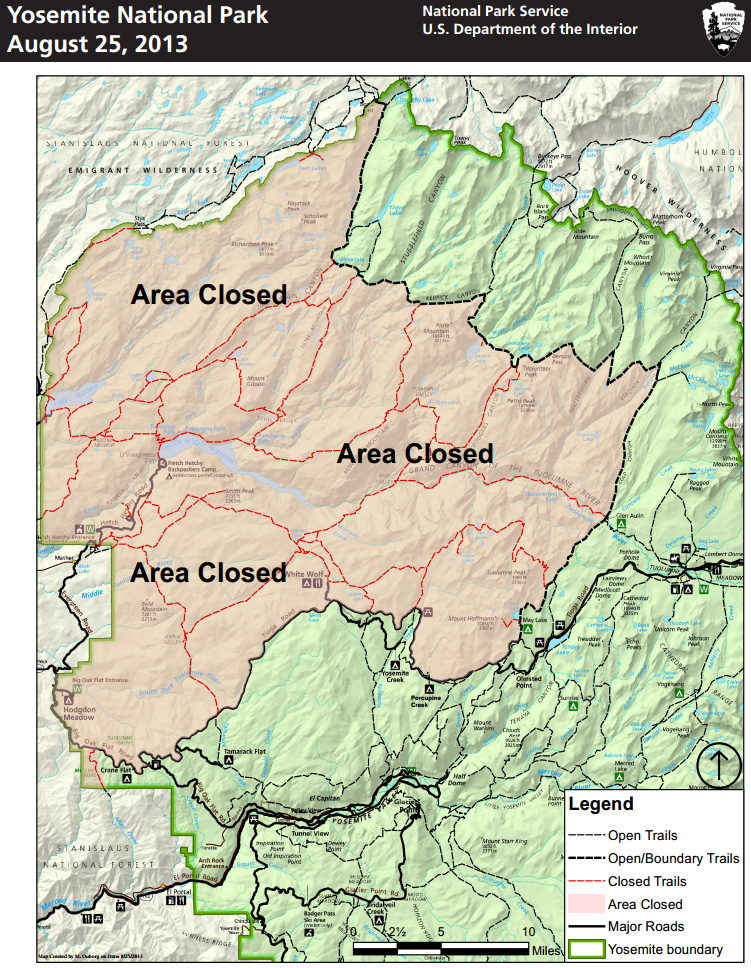
Rim Fire Closes Areas of Yosemite National Park

At 10:41 am this morning Yosemite National Park distributed a map of closed areas within the park, generally north of CA-120 and east of Glen Aulin, as shown on this map:


Details of the Yosemite National Park closures may be found at:
http://www.nps.gov/yose/planyourvisit/rimfire.htm

On Twitter Cal Fire sent out a tweet on current conditions this morning at 7:35 am:

[update] near (Tuolumne County) is now 149,780 acres & 15% contained.

Cal Fire's page for incident updates is found at:
http://inciweb.org/incident/3660/

The latest Cal Fire map color-coded to show daily progress of the fire is available at:
http://inciweb.nwcg.gov/photos/CASTF/2013-08-17-1950-Rim/picts/2013_08_26-14.11.21.961-CDT.jpeg