Showing posts with label USA. Show all posts

Sunday, February 19, 2017

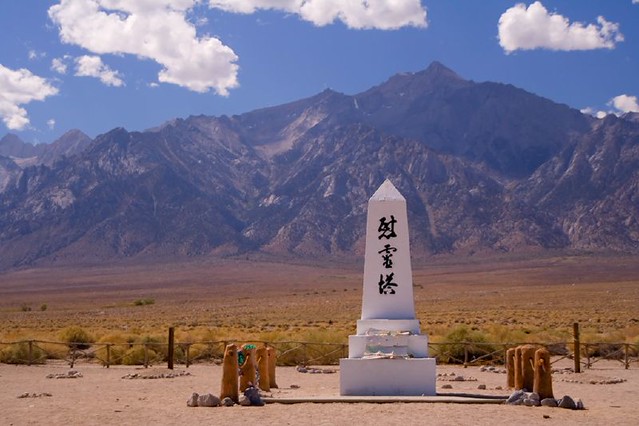
Manzanar National Historic Site

Manzanar National Historic Site, California


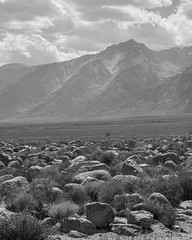
Mount Williamson, Sierra Nevada, from Manzanar
On February 19, 1942, seventy-five years ago today, the President of the United States authorized our government to incarcerate Americans. More than 110,000 American citizens and immigrants of Japanese ancestry were forced to give up their homes, businesses, and ways of life. 

This chapter of American history is included in history and civics education in California, but it doesn't seem to be common knowledge nationwide.


Ansel Adams photographed in and around Manzanar while it was in use.  My 2006 photo to the right was taken near where he captured his photo "Mount Williamson, Sierra Nevada, from Manzanar".

I included Manzanar on page 90 of in my 320-page photographers' guidebook "Photographing California Vol. 2 - South".


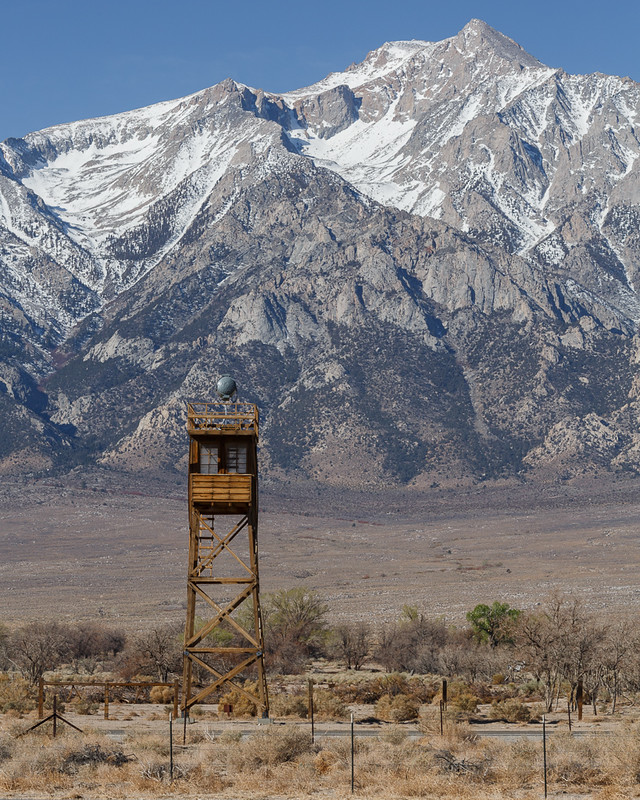
Manzanar Internment Camp

Thursday, August 23, 2012

Night Workshops at Bodie State Historic Park


Whether your interest is moonlit portraits of the old buildings, light painting, star trails, Milky Way images or night timelapse photography, we can cover a lot in the space of a few hours!

We will meet in Bridgeport for an early dinner (no host) before we head out to Bodie. Dinner will be around 4:00 pm Saturday to allow us time to meet, eat and drive to the ghost town.  We will be greeted at the gate by our guides for the evening.  After a brief introduction from the Bodie Foundation, we will start our evening of photography from about 6:30 p.m. on, with a departure time of 1:00 a.m..

These are the last night workshops we'll schedule for 2012, and registration will be accepted on a first come, first-served basis.  Credit cards can be used to register through the PayPal links in the right column, or if you'd prefer to mail a check, contact me.

September 22nd  
Workshop Fee:    SOLD OUT!

October 6th
Workshop Fee:   SOLD OUT!

Although our planned night photography workshops for Bodie this year are full, if you have a group of several people eager to go, contact me and perhaps we can schedule a new date.


Tuesday, June 12, 2012

New Google+ Page for Workshops at Bodie State Historic Park


To help people find my upcoming photography workshops at Bodie State Historic Park, I've set up a Bodie Photo Workshops page on Google+https://plus.google.com/b/116719515450184310739/116719515450184310739/posts
Stay tuned for date announcements, or contact me to get on a list to receive updates.

Find us on Google+


Monday, December 12, 2011

Chasing The Moon: Lunar Eclipse December 10, 2011

Having shot lunar eclipses several times in the past, my objective this time was to see whether I could line up the Eclipsed moon with a major landmark. I selected San Francisco's most iconic building, the Transamerica Pyramid. The time I chose was 6:06am, right when the eclipsed moon should be coming out from total eclipse and brightening back up. I looked up the height of the building, the elevation angle of the moon at that time, and that enabled me to calculate the distance I would need to be from the building. I determined the compass direction the shadow would fall, and located point on Google earth with the right direction and distance.

 I set my camera up in that spot 10 minutes early, and here's how the next 10 minutes turned out:
I pretty much nailed it... the center of the moon passes right past the tip of the building!


Here are some more of my images from that night:

Friday, December 09, 2011

Lunar Eclipse Photography, Dec 10, 2011


For tonight's moon rise and lunar eclipse events, there are a range of shots available:

Moon Rise: Friday evening before sunset (about 4:15, but time varies with location)
Sunset: Continued moonrise in best post-sunset color (about 5pm, but time varies with location).

Penumbral Eclipse Begins: 3:33am PST, moon at 41.4 degrees altitude
- Night landscapes or cityscapes with full moon in penumbral slightly dimmed state
Partial Eclipse Begins: 4:45am PST, moon at 27.0 degrees altitude (partial eclipse)
- Telephoto shots of moon in various eclipse phases
Total Eclipse Begins: 6:06am PST, moon at 12.3 degrees altitude (nice crescent moon w/red shots in the moments before this)
- Images of red moon and sky over landscapes/cityscapes
Total Eclipse Ends: 6:57am PST, moon at 2.9 degrees altitude
- Partially eclipsed crescent moon setting in best pre-sunrise light
Sunrise: 7:12am PST, moon at 0.4 degrees altitude (partial eclipse)
- Sunrise to moonset, "golden hour" daylight
Moonset: 7:17am PST, moon at -0.3 degrees altitude (partial eclipse)
- If you're in a very high place with very low horizons, for a few short minutes you may be able to capture a panorama, with the rare event of having both the sun and the moon in the sky at the same time!

The additional numbers are the degrees the moon will be above the horizon. Here's a chart enabling you to anticipate which of your lenses can cover something that high, for the shots where you'd like to include both the ground and the eclipsing moon:

Common lens angles of view
http://en.wikipedia.org/wiki/Angle_of_view#Common_lens_angles_of_view

If you shoot the entire eclipse in a sequence of still shots with your camera in one place, you can assemble them into a timelapse video like this one:


The other post-processing option for a sequence would be to create a composite photo of the phases, stacked into one image using software such as the free StarStaX:

Lunar Eclipse August 2007
Lunar Eclipse at Mono Lake


Here are my planning notes from last year, when it took me 46 hours to reach Tucson and a clear patch of sky to shoot the eclipse under:

Phases of the December 2010 Total Lunar Eclipse
http://activesole.blogspot.com/2010/12/phases-of-tonight-lunar-eclipse.html

For most viewers the apparent moon set time will tend to be a few minutes earlier due to terrain (or fog/smog).

Hopefully I'll find it a little easier this time around. The next total lunar eclipse isn't until 2014, so make the most of this one!

Wednesday, August 10, 2011

South Lake Tahoe Fireworks Ranked #6 in America

Fireworks in South Lake Tahoe

I've seen fireworks displays in at least a few dozen locations in America, over cities, theme parks, mountains, the ocean, and lakes. This Summer I saw the best I've seen yet, in South lake Tahoe. Ranked #6 on the top 15 by AOL, (July 4th Fireworks: 15 of the Biggest Shows in America Ranked), it offers some of the most interesting and innovative burst patterns I've seen. The pace is great, choreographed to music playing on a local radio station.  If you live within driving distance, it's definitely a show to put on your bucket list.

Impeccably choreographed fireworks display.

Wednesday, June 08, 2011

In Search of a Magazine Cover Photo


Other Worldly, originally uploaded by Jeffrey Sullivan.

A couple of weeks ago Outdoor Photographer Magazine issued a call for potential cover photos. Always up for a challenge, I first created a quick set on Flickr of vertical landscape shots to sort through. There were some good candidates, but I really wanted this, so I decided to keep the cover in mind as I pursued night shots in the Eastern Sierra this week.

My first stop was Mono Lake. I arrived at 9pm, just as the stars were coming out and the Milky Way was starting to peek over the southern horizon. It was the night of the new moon, so with little ambient light to illuminate the foreground, I brought a selection of flashlights to provide light on the tufa rock formations. I used my typical 30 seconds at f/2.8, ISO 6400 dark night exposure, but I added a small amount of fill light. My LEDs were too blue on the light-colored tufa towers, and direct incandescent flashlight beams were too bright and created too much contrast. I was able to resolve this by moving around during each exposure and reflecting light off of nearby tufa towers, and if none were available, even using my face and hands as portable, positionable reflectors. Cup your hand, and the light is even controllable in general directions! I shot a variety of stills and star trail sequences, finishing with the shot above which allows enough room for a magazine title, articles and so on.

So one decent shot down, I moved to the Buttermilks, where I had a North Star star trails shot in mind. I arrived at 2am, but someone was parked there, camping where I was going to shoot! By the time I moved to another campsite, there was no way I was going to get up in 2 hours for sunrise... I slept in!

I was generally headed toward Kings Canyon and Sequoia National Parks, so in the morning I explored 4WD roads and checked current conditions in the Bishop Creek drainage, then moved on. I arrived at the Alabama Hills, again just in time for night shots.

I scouted out some locations and angles for night workshops, but the clouds were just thick enough to interfere with the production of great Milky Way or star trail shots. By midnight I moved to a decent sunrise location and called it a night.

The next morning I woke at my usual 45 minutes before sunrise (4:45am this week), and the clouds were broken but still blocking the sunrise color. Lacking any particular reason to get up, I stayed in my PJs and waited to see how things developed.


A while later shafts of light started illuminating Mt. Whitney. Game on! With no time to change, I just ran around in my PJs, switching lenses to catch a variety of compositions as the light evolved. I caught at least one dramatic but relatively simple composition of Mt. Whitney that should work well for a cover.
Mt. Whitney from the Alabama Hills
Even with the bust the night before, I felt that I had two solid contenders in two days... a decent start.

I continued south towards a southern hook around the Sierra Nevada and turned toward Kennedy Meadows and a scenic shortcut. The road was closed, and the forecast said it would be raining and snowing over in Kings Canyon for the next few days. Rain and wind was forecast locally as well, but I wasn't going to ditch the trip after two days, so I headed out into the Mojave Desert.

The next morning delivered nice sunrise color, and as I moved around a dry lakebed catching various compositions, there was also a short section of rainbow! The sunlight was really nice as it arrived as well. Third contender, maybe even a fourth.


That night the wind was howling. I literally turned on my lights at one point to see whether someone was rocking the vehicle back and forth as some sort of joke. My SUV was getting sandblasted, and my lenses would too... no shooting tonight.

The next day I took shelter in a coffee shop and went back out in time for another nocturnal adventure. Just as I was approaching a railroad crossing, a train stopped across the road! Google Earth confirmed no reasonable detours. I'd wait, maybe sleep, until the train moved.


Two hours later, it creaked and groaned out of the way, and I was back in business. I shot some moonset shots and started a star trails sequence.

I went to the other side of the car to set my alarm for sunrise, to avoid having light pollution in my shot. I heard something in the gravel on the side with my camera, so I walked around the back to see what was up. I nearly tripped over an animal, which startled and ran, which startled me nearly out of my shoes. I turned on a light, but never saw what it was... judging by the noise, probably a fox or small coyote.

As i started the timelapse I had seen the moon's light shining on some rocks witht he Milky Way overhead, so I headed over to see if they still had any remaining glow on them. They didn't have much if any, but it still made a nice concept, and I could simulate it with light painting. I tried it a few different ways and Bingo! Next candidate on the card.
Far Away (entry in OP's "Cover" assignment)

The Milky Way was really nice, so I decided to leave the camera running all night. It captured 400 frames in the 3+ hours before dawn light washed out the exposure. That yields a whopping 13 seconds of timelapse video: http://www.vimeo.com/24802819

Far Away from Jeff Sullivan on Vimeo.


Checking the weather forecast the next day I finally gave up on the idea of going to Kings Canyon. So I returned to the Alabama Hills, but although I arrived as the moon was tucking down behind the Sierra Nevada after midnight, I was too tired from the drive and the cumulative lack of sleep.

On the following nights the moon would be too bright and stay in the sky too late for Milky Way shots. Time to call the night photography quest a wrap! To round out 5 entries, I ended up choosing two from the trip, a recent Yosemite star trails shot, and added two seascapes from my portfolio for variety. Done. On to the next project!


Star Trails Over Yosemite Falls Weston Cove Sunset Cannon Beach Cloudy Sunset

Friday, December 31, 2010

Owens Valley Rainbows (Timelapse Video)

Rainbows I found in the Owens Valley on October 5, 2010 while scouting conditions for the Fall Colors workshop. The rainbows move across the landscape as the sun moves across the sky.

Best viewed in high definition over on Flickr!

Wednesday, October 27, 2010

Wind and Rainbows in the Eastern Sierra


Rainbow in the Wind, originally uploaded by Jeff Sullivan.

The wind was literally ripping water off the wavetops in Mono Lake on Sunday. Gusts up to 80MPH were reported in the Eastern Sierra valleys, with up to 145MPH forecasted on the ridges.

Fall colors will linger on primarily in wind-protected areas.


Monday, October 25, 2010

Fall Colors Peak in the Eastern Sierra


June Lake Loop Fall Colors, originally uploaded by Jeff Sullivan.

Fall colors peaked in many areas of the Eastern Sierra by last weekend. I enjoyed some of the most varied and saturated colors in years along the June Lake Loop on Friday. I returned on Sunday to find ample colors remaining, but the colors were faded and by the afternoon hevay winds had arrived and many of the trees were having their leaves blown off. Pockets of good color and some green leaves still to change do remain, and trees at lower elevations such as cottonwoods down by Bishop have a slightly later season, but many of the largest aspen forests have declined substantially after Sunday's storm.


Wednesday, August 25, 2010

Perseid Meteor Showers

My next photography adventure was heading out to shoot the Perseid meteor showers. After a realtively weak showing at the first night at Mono Lake, in part due to the large amount of dust in the air there (great for sunrises, not so great for seeing stars or meteors rising over the eastern horizon), I drove down to the higher and clearer Ancient Bristlecone Pine Forest.


This time I had spoken to Tom Lowe several times in the weeks leading up to the event and I decided not to wait to capture the crescent moon setting over the crest of the Sierra Nevada before driving up to the Patriarch Grove at 11,300 feet. Several other photographers on Flcir who had expressed an interest in shooting this event had communicated that they would not be making it after all, but photographer Jean Day was expecting to join us. As luck would have it, her truck was up on a jack with a flat tire, shortly after Schulman Grove, still 10 miles and at least a half hour to 40 minutes short of my destination.

Even worse, someone who stopepd to help had overextended the jack, breaking the handle in the process. I had both cans of Punture Seal and an air compressor built into my minivan, but my jack was too short, so I shot the crescent moon descending behind some communication towers while we waited for an adequate jack.

After several people stopped we eventually were able to get the truck down off its jack, and drive, inflate, drive, inflate our way to highway 168 before the leak in the tire got too bad to reinflate. Fortunately we had been able to flag down a flatbed tow truck on its way to another call, who would now be looking for her as he drove out. Jean urged me to get back up there and shoot, so I headed back up.

To make a long story short, I was off to a late start, but I found a shooting location which would not get lit up by late arrivals, and set my camera and intervalometer timer loose to capture hundreds of consecutive 30 second shots.


Tuesday, July 06, 2010

Twisted Trunks: The World's Oldest Living Things

As my kids and I were flying around the Eastern Sierra last week, it came up that they hadn't visited the Ancient Bristlecone Pine Forest. It's an amazing place, and given the heat of the Owens Valley that week, an elevation of 10,000+ seemed like an even more attractive place to be.


In addition to being interesting for their exotic shapes, bristlecone pine trees are very long-lived. One nicknamed "Methuselah" was measured via a coring tool to be 4789 years old in 1957, so it should turn 4842 this year. In 1964 another specimen "Prometheus" was determined to be over 4000 years old, but the coring tool broke, so permission was given to cut it down. It turned out to be at least 4844 years old when it was killed.
We reached the Patriarch Grove after sunset, but we still had enough light to get some shots.


My daughter found this unique "wooden arch" etched into one of the tough old trunks.


The next morning we woke up in BLM's Grandview Campground at an elevation of roughly 9000 feet, and we found a scorpion outside the tent... right next to our shoes!

Dawn of Opportunity


Dawn of Opportunity, originally uploaded by Jeff Sullivan.

My memory gets a bit hazy on the details as I dragged myself through a sequence of relatively sleepless days, but eventually I woke up early enough to shoot a timelapse sequence of the sun rising over the Bodie Hills off towards the horizon.


The Bodie Hills are among 14 areas being considered for National Monument status. Many of them are rarely-used areas of BLM (Bureau of Land Management) land, which enables you to go use them to your heart's content with minimal restriction. National Monument status could close them to maost use, except in developed campgrounds. You'll then be charged for the "improvements" (the sound of adjacent generators and drunken rednecks blasting country western music... sorry, just my recent experience in campgrounds during the past 2 weeks...), they'll probably charge National Monument/National Park $20-25 fees instead of the BLM's mroe typical $2-3 (when there's a fee at all), and the added attention will ensure that the lands get far more trampelled and whatever endangered wildlife allegedly needs "protection" there will be more challenged and endangered than ever before.

Don't worry though, there's a group of people in Washington who believe that their sole purpose in life is to obstruct anything that the President does (never mind that meeting in the middle is often the healthiest approach for citizens of the country), so eleven lawmakers have introduced a bill to block the administration's ability to create monuments. I'm clearly no knee-jerk supporter of converting these lands to monuments, but I have huge reservations about blocking the ability to create them when appropriate (and when that symbolic move won't actually cause worse problems). Isn't the two-party system supposed to result in rational, middle-of-the-road compromises which actually make sense? Why do we seem to have a recent rise in extreme polarization and rampant dysfunction? Is it simply a case of "because it works" (to make politicians bribe-rich), combined with a gradual erosion of adequate controls to punish people when there's excess?

We didn't venture into the Bodie Hills on this trip though. Instead we stuck along highway 395, heading up to Big Meadow near the town of Bridgeport to meet with Tom Lowe of www.Timescapes.org. We found a nice patch of iris growing in an irrigated pasture (replacing the ubiquitous sagebrush in the area), we explored some side roads where I shot some "sundog" rainbows in the sky, and we watched some large young hawks sitting in a nest on a power pole, while "Mama hawk" circled overhead, watching us.
We finished the day back in the iris field, with Tom filming my daughter walking in the warm light of the setting sun.