As I read the various forecasts about what improvements might appear in the
Canon 5D mark III, I manly see lists of slightly improved technical specifications. Those types of improvements are good, but are you really understanding and solving the challenges that current customers are facing? Are you also looking at not just evolutionary improvements, but revolutionary ones as well?
Digital cameras seem to be limited to simply copying the functionality of, and the limitations of, analog film cameras. This is unfortunate and unnecessary. True innovation will give some camera company a commanding advantage in the market. Will it be you?
Your customer base has changed dramatically. Your typical customer even for your highest end cameras has little to no experience. Accept and adjust to that fact. Make your products much more approachable to these new customers, and you will have a major competitive advantage.
With far more customers who are relatively new to photography, it's time for you to address the limited and poor quality information included in your manuals. Don't just describe how to navigate through the menus and how to change settings. Explain what situations those settings are actually useful for. Have a complete and expanded rewrite done in English. Let me download your manual to store, search and use on my iPhone and on iPads. I won't pay more for that (and there's no reason why you can't release the manual in that format... allow others to post it online if you're too cheap to host a couple of servers to provide that service). As I'll explain below in much more detail, there are many features which you may wish to change if you consider more carefully how your cameras are actually being used today.
Your customers are using HDR. A lot. Even people who don't use HDR specifically use other forms of exposure blending: layer masking, image stacking, and so on. These uses are increasing throughout the market, so your performance on multi-shot modes will either become a strategic opportunity to increase market share, or will become a strategic weakness of your cameras. Put a lot of time, thought and effort into improving and extending your multiple exposure modes.
-
Create an HDR-friendly Automatic Exposure Bracketing mode which automates the AEB-setting process so the user selects the center exposure value, but the camera selects the brighter and darker exposures to preserve highlight and shadow detail. Let those two additional exposures be asymmetrical, such as one stop brighter and two stops darker. This would be highly valuable to any photographer who might blend exposures via any technique, not just HDR. Don't assume that the feedback you get from a few top professionals (who are comfortable setting bracketing) reflects what your typical customer needs; if you can improve the HDR results of a beginning user, as they share those with their friends you will gain market share.
- Limiting AEB sequences to 3 shots is not acceptable, and not competitive with Nikon. I may only choose 3 shots to process out of the 5 or 7 I shoot, but I want the RAW files available.
- Limiting AEB sequence spacing to +/-2EV shots is not acceptable.
Many customers are producing timelapse sequences, or will be soon.
Consider the usability and performance of your camera for producing timelapse videos.
- For sunset and sunrise, the light changes too much over time to set a single manual exposure. Few of your actual customers have a tripod sturdy enough to allow touching the camera to manually change exposure during the timelapse (and that approach would be too prone to inconsistencies anyway). Yet trying to automate exposure adjustment by using Aperture priority mode, when the camera is about to change to the next 1/3 of a stop brighter or darker, sometimes the camera goes back and forth between brighter and darker exposures, creating unnecessary flicker in the results. One solution would be to
create a Timelapse Mode, where the exposure trajectory can be considered (comparison to a moving average), so abrupt back and forth exposure changes will not occur.
- There is no reason to have a computer (digital camera) act in such massive increments as 1/3 stop of light. At least when the camera is operating
in Timelapse Mode as described above,
let the camera adjust itself in much more gradual exposure increments, such as 1/10th stop.
- There is a need for faster frame per second performance, preferably 6 or more. This helps reduce long term performance bottlenecks over the course of a long timelapse.
- Try using the 5D mark II for timelapse sequences with a long lens. When I'm using mirror lockup with an external timer, give me the option of leaving the mirror up, rather than have it slap back and forth, wearing it out and inserting 2 more seconds between exposures.
-
Solve serious performance bottleneck issues with the 5D mark II: The current 5D mark II performance breaks down during sustained shooting. While rated at 3fps for burst shooting, when shooting timelapse sequences of several minutes to an hour or more, it becomes apparent that the actual long term fps performance of the current 5Dmark II is less than one frame every 5-6 seconds. So on the Canon 5D mark II, actual performance experienced by real users can be 18X lower than the specifications commonly advertised! This is not an insignificant shortfall in a $2699 camera (mine was close to $3000 after California sales tax)! If you try to shoot at any faster rate, the camera occasionally gets bogged down processing RAW files and skips a scheduled frame in the timelapse as it tries to catch up. I haven't done the math to calculate whether it's simply a bandwidth issue since I use a 533X card, but neither will most other photographers, If there's a specific card we need for certain types of performance, first know that yourself, then tell your customers what they can expect at various card performance levels. Do I really need the newest, fastest $300 memory card, or will a reasonably fast one closer to $100 be sufficient?
Unconventional features - Sometimes camera manufacturers seem to lack experience and imagination when it comes to how their camera features are being used or could be used by members of their broader customer base.
Get used to the fact that 99% of your customers are not too proud to use automatic modes or simple accessories like built-in flash. Some people are really into setting up custom modes, but I suspect that most professionals will use whatever works; whatever saves them time and produces results in a predictable and consistent manner.
Flash: The lack of pop-up flash appeals to many elitist snobs, but such a bias is short-sighted, overlooking practical applications. If I'm out shooting a landscape, and a bear, deer, elk, pine martin, bird, moose shows up and all I want is a little catch light in the eyes, do I have the luxury of being able to dig into a bag and pull out a flash (miss the shot timing and/or scare them away witht he movement)? Or can I trust that an external strobe is charged in the days or weeks since I've used it last? Do I want to carry the rock-like Canon 580EX when I go backpacking? No, no, NO! Or could a pop-up be better than nothing in those fractions of a second before a shot might be lost? There are times when the clunkiness of an off-camera or shoe-mounted flash is acceptable, other times when the next best thing would be far better than nothing. This is another great example of where you'd probably get a very poor indication from traditional top photographers on what the majority of your actual customer base might actually find useful. I'd even accept a flush-mount built-in flash instead of nothing; just make sure that it has a daylight color temperature.
Modes: give me a Sports mode that shoots in RAW for random wildlife appearances (also Portrait and Night Portrait, also respecting my RAW setting). I don't want to have to reinvent them using custom modes C1-C3 (I also don't want to give up RAW results, a full frame sensor, ISO 6400, etc. either).
Night photography is one of the big incentives your customers have to upgrade to the 5D mark II or its replacement. Consider a wide variety of night applications and improve or add relevant features:
-
Let me set exposures longer than 30 seconds, in-camera. 30 seconds is not long enough before requiring the camera to be used in Bulb mode. Why were cameras limited to 30 seconds in the past? Probably because film suffered reciprocity failure. That's gone, so drop the limitation. For evening seascapes I'd like to be able to produce three bracketed exposures, with the shortest at 30 seconds and at least one exposure at 2 minutes, so if that's the middle exposure the longest one would be 8 minutes. I want to be able to use that 10 minutes to do something else (shoot my backup camera); don't make me stand there and time (or delay the interval between to program my intervalometer to time) 3 different Bulb exposures!
-
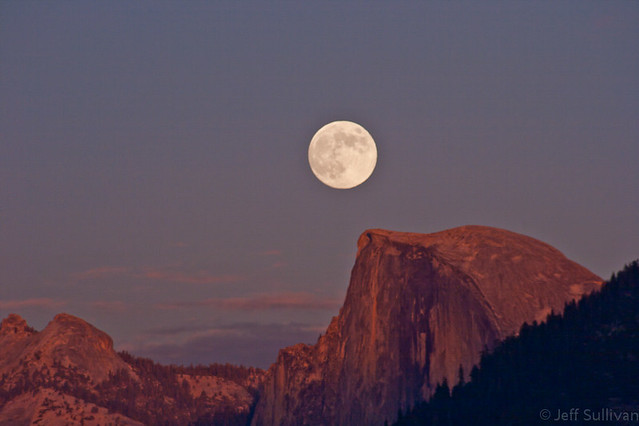
Add a "Full Moon" AEB mode. While I'm optimizing my AEB sequence to cover the foreground, midground and background, let me turn on a mode to automatically add one reasonably close exposure for the full moon. I currently have to fake this by working in one mode such as Aperture for the landscape then rotating the mode into manual mode for the moon, but that introduces a time delay during which the moon moves, and for night exposures it is unacceptable to have to touch the camera (jostle the camera and tripod) between exposures which are intended to be merged later.
-
Build the intervalometer into the camera. It's in Nikon's D7000, it was in the Canon Powershot G5, so where's yours now Canon? External cables cost more, take space, add weight, and they are prone to failure.
- ISO 12,800 and/or 25,600, and better low noise performance at ISO6400
- Make sure you keep the dual Digic processors, and that noise reduction even on long, high ISO night exposures can be completed within a fraction of one second after the shutter closes.
Video features and performance: Canon seems to currently have an edge over Nikon in video features across much of their product line. Rumors claim that video development is progressing separately from still image features, and this may lead to two separate camera models. I feel this would be a strategic mistake to lose the competitive advantage of having a camera that does both. The video features on the 5D mark II were very well received by the market, and If you paid a little more attention to features and usability this lead could be maintained:
- stereo microphone, with better wind screening
- Make video mode more usable: sound level meter, etc.
- Higher ISO video shooting
Improve handling of dust, and do so in our typical workflow! Current approaches for handling dust (shaking sensors and so on) are very inadequate. Postprocessing is a critical point in the process to add value:
- That's great that Canon has the concept of capturing Dust Delete Data and at least in theory can use that data to reduce the appearance of dust spots in Canon's Digital Photo Processing (DPP) software. But on days when I have 600 separate images to process from a day, or if I have a 1200 image timelapse sequence, where exactly do you expect DPP to fit into a typical workflow? How would I transfer the data to efficient workflow tools like Lightroom? I produce 16-32GB of images per day in RAW format, I can't add intermediate TIFF files of 120MB each (a total of over 400GB of data per day).
DPP should be implemented as a plug-in for Lightroom, possibly for Photoshop as well.
- there is a need for a
timelapse editing tool, which preferably could be integrated into Adobe Lightroom as a plug-in, which would adjust long term trends in exposure across dozens of photos.
Other improvement requests in the next generation:
- Higher resolution (not the most critical requirement though... don't sacrifice improvements in high ISO / noise performance!
Revolutionary Improvements
My iPhone is a computer with 32GB storage.
-
Smart Phone Control - Offer an interface to enable iPhones, iPads and Android devices to control my camera (I suspect that third party solutions exist, but it is strategic for you to fully understand the uses, needs, and future potential of this type of application). Bluetooth wireless?
-
Apps - Look at the rich market for "iPhoneography" post-processing applications. Enable users to add third-party apps programs which can facilitate and perform non-destructive postprocessing, and to transfer RAW files over to Lightroom with those changes non-destructively applied in my Lightroom catalog. This enables the entire iPhone developer community to add value to your camera. There is little limit to what the imagination and resources of such a developer community might produce. Again, it may be strategic for you to be very closely involved in facilitating such applications.
- As prices come down, an iPhone-like computer and display could be built into the camera.