 |
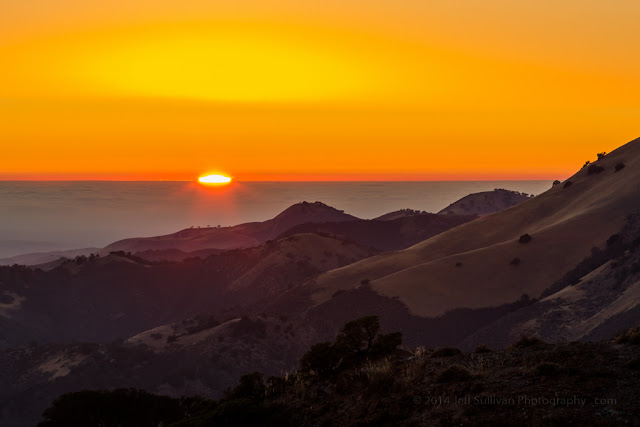
| Sunset from Figueroa Mountain Road |
Are you looking for a place to find wildflowers along California's Central Coast? Figueroa Mountain can be a great place to see wildflowers when the timing is right. Helen Tarbet of the Los Padres National Forest sent out her first wildflower update of 2016 to email subscribers on March 18. She reports that
"California poppies are blooming throughout the mountain" and
"Other wildflowers to look for as you continue your uphill climb include, buttercups, goldfields, coreopsis, shooting stars, ceanothus, California poppies, Mexican elderberry, blue dicks, fillaree, royal lupine, lomatium, fiddlenecks, beautiful pink prickly phlox on the serpentine rock formation on the right and lovely orange wall flowers just beyond that. Also, you will see strikingly beautiful Catalina mariposa lilies in the open grassy fields and wild canyon peas in some shaded areas. At Vista Point (large gravel turnout about 11.4 miles from the bottom), exquisite chocolate lilies are in bloom..."
The variety along this road can be stunning. I hope to get back down there next week, but in the meantime, here's my description of Figueroa Mountain Road Recreation Area on page 218 of my
Photographing California - South guidebook, illustrated with a few extra photos:
---
Figueroa Mountain Recreation
Area, Los Padres National Forest
Home to an annual wildflower bloom each spring, Figueroa Mountain provides a variety of species at various elevations, diversifying your opportunities and extending the wildflower season. The U.S. Forest Service often provides updates on the timing and progress of the wildflowers as they emerge in the February through April time frame, so if you have the opportunity, check their Web site for current conditions.
Photo advice: A selection of lenses will help you capture a
variety of perspectives on the flowers. California poppies are one of the most
common species of wildflower here, and they don’t open until they have warmed
up in the sun, so it’s not necessary to rush up here for sunrise.
Getting there: From US-101 take CA-154 East, San Marcos Pass
Road, 3.0 miles, turn left on Figueroa Mountain Road.
This is a narrow mountain road and your drive on it may take you 15 miles or
more and increase in elevation 3000 feet. It is not recommended for large
vehicles or trailers.
Time required: You’ll probably need 2 - 3 hours or more to
navigate the road and have some time for photography.
Nearby location: Also in the spring, the oak-laden hills and
pastures in the first mile or two of Figueroa Mountain Road may offer
wildflowers such as wild mustard.
---
 |
| Lower Figueroa Mountain Road |
After enjoying the wildflowers, consider exploring the town of Los Olivos and the wineries of the Santa Ynez Valley.


 This is a narrow mountain road and your drive on it may take you 15 miles or
more and increase in elevation 3000 feet. It is not recommended for large
vehicles or trailers.
This is a narrow mountain road and your drive on it may take you 15 miles or
more and increase in elevation 3000 feet. It is not recommended for large
vehicles or trailers. 


