Showing posts with label Mojave Desert. Show all posts

Friday, August 14, 2015

Perseid Meteor Shower 2015

2015-08-14-1439588880-6591901-StarStaX__46A8412_46A8817_lighten201.jpg

Comet Swift-Tuttle only passes the earth and circles the sun once every 133 years, but the earth passes through its trail of dust every year.  The debris field is large, so Perseid meteors may be seen on nights from July 17 through August 24.  The earth passes through the most dense portion of the comet's dust trail on the night of August 12-13, so that is when the peak, or maximum hourly rate of meteors, is seen.

On any given night, the sun sets as your position on the earth rotates away from the sun, then around midnight you rotate to a point directly opposite the sun. As the earth also moves in its orbit around the sun, your position on the earth is just starting to rotate to the side of the earth leading its movement through space, which collides with more debris. So meteor rates go up starting at midnight. At dawn you're approximately in the middle of the face of the earth as it flies through space, so meteor rates continue to climb slightly towards dawn. So the best bet in the evening is after midnight, in the last hours of darkness before the dawn's oncoming light brightens the sky.

This year I pursued the Perseids on the mornings of August 9, 11, 12 and 13. The best viewing was on the peak morning of the 13th, as expected. The composite photo above shows many of the meteors that my camera picked up over the course of nearly four hours.

I also assembled a time-lapse video that condenses several hours of meteor activity into seconds of video. You can see it on Vimeo here:


Perseid Meteor Shower 2015 from Jeff Sullivan on Vimeo.

Not everything that moves in the video are meteors; the meteors are the brief streaks of light, the slower ones are airplanes.  As you see the Milky Way and stars move, that is from the rotation of the earth. You can also see smoke from forest fires.

According to Wikipedia, Comet Swift–Tuttle has been described as "the single most dangerous object known to humanity". But don't worry, its next close encounter with the earth isn't expected until the year 4479. With a nucleus 26 kilometers across, if there were an impact, the force is estimated to be 27 times larger than the one which formed the Chicxulub crater beneath the Yucatán Peninsula in Mexico, which is believed to have caused the extinction the dinosaurs.

Doomsday preppers take note, you only have 2464 years to get ready!

Sunday, May 10, 2015

Route 66 in the Mojave Desert

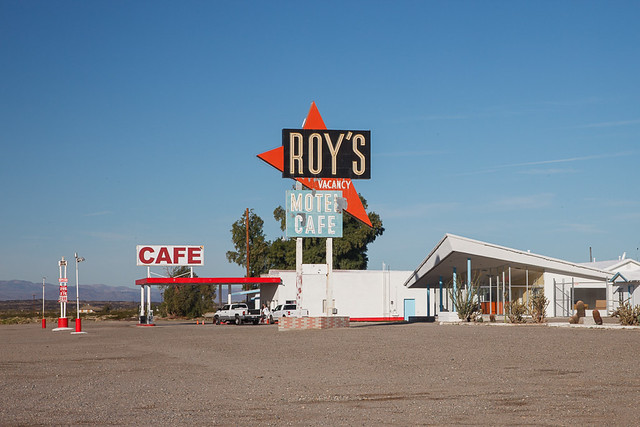
Roy's Motel Cafe on Route 66
Roy's Motel Cafe alongside historic Route 66
In the spring months I'm often passing through the Mojave Desert, which puts me on historic Route 66.  There are a number of old houses and businesses along the way, mostly in various states of disrepair, but there's a nice cluster of buildings worth checking out in the small town of Amboy, including Roy's Motel Cafe, the deserted and overgown Amboy School, and a picturesque, if dilapidated, church.


Amboy Crater
Spring is also the time for wildflowers in the desert, so if you catch the timing right, you can see many species like this desert sunflower with Amboy Crater in the background.  Amboy Crater is a couple of miles west of Amboy alongside Route 66, and if it's not too hot you can walk about a mile to the crater itself.  The trail winds its way around black lava flows, which warm up in the sun, so brings plenty of water.


Chuckwalla
If the plants are growing green in the area, keep a sharp eye out for several species of large lizards in the lava, including chuckwallas, which grow to 18" long and nearly 2 pounds in weight.

From Amboy you can travel north to explore Mojave National Preserve and Death Valley National Park, south to explore Joshua Tree National Park, or west to Baker and up the Eastern Sierra.

A short distance to the east of Amboy, the walls of a building have been turned into a canvas for graffiti art.
East of Amboy

This area is covered in my 320-page guidebook to landscape photography in Southern California, coming this September (www.PhotoTripUSA.com).  In the meantime, if you'd like to buy the Northern California guidebook in the series, written by photographer Gary Crabbe, I've placed Photographing California Vol. 1: North - A Guide to the Natural Landmarks of the Golden Statein my recommendations on Amazon.  If you access Amazon through this link, your purchases there will can fund these travels and reports, and the development of my guides: http://astore.amazon.com/jeffsulliphot-20 

Amboy Church


Saturday, May 02, 2015

Time-lapse of the Milky Way Rising in the Mojave Desert

In late April I was out camping in the desert, and I set an alarm to get up in the early morning hours to catch the Milky Way rise.  Around 1 am the first bits of it were just rising over the eastern horizon, so I set up two cameras, to catch both static and panning views of it.

The camera on a stationary tripod captured images that I could also process to create star trails images:

See the link to my star trails tutorial below
 Here's the time-lapse video captured on a second camera, using a sky-tracking, panning mount:


Digital Rights Management by Nimia

 Here's the time-lapse video captured on the stationary camera:


Digital Rights Management by Nimia

I set another alarm to wake up near sunrise to stop the time-lapses, and with one of the cameras I captured multiple shots to stitch together a panorama of the Milky Way, now forming a high arc in the sky.

Milky Way Over Joshua Trees, Panorama
It all turned out really well.  I should sleep at work more often!

Here's some introductory information on night photography techniques, in case you want to try yourself:
How to Capture Milky Way Images

Create Star Trails Images


I can show you more advanced techniques as well as these in more detail during night photography workshops in the "ghost town" of Bodie. We have five workshops scheduled in 2015, with dates available from May through October.  Several of the workshops also offer special escorted access into building interiors, which are not generally open to the public:
http://www.jeffsullivanphotography.com/blog/bodie-night-photography-workshops/


P.S. - Thanks in advance for lies, shares, +1s, comments, or any other honors that you choose to bestow on my blog posts!  With my book done, I'm trying to get a lot more active on updates to my blog, so you should see a lot more activity and updates here in the coming weeks and months.  I also have a "new"(er) blog, which I use to consolidate social media posts to: www.JeffSullivanPhotography.com.