Showing posts with label superbloom. Show all posts

Saturday, March 12, 2016

Death Valley "Super Bloom" 2016: Best Wildflower Sites

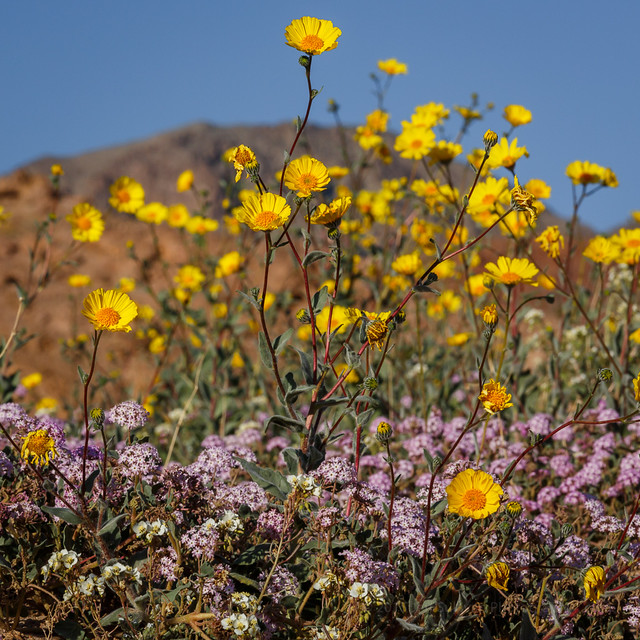
Lower Warm Spring Canyon Road from miles 1 to 3 had declined slightly... to this! Still better than a "normal" year.

Last week I repeated and expanded the complete south to north traverse of Death Valley National Park that I had scouted in February.  How were the wildflowers holding up?  What were the best locations?  The Park has been issuing detailed reports, so let's use the March 2 and February 24 reports as a baseline, and I'll illustrate current conditions with my photos.
-----

Mile Marker 42, Badwater Road
March 2, 2016

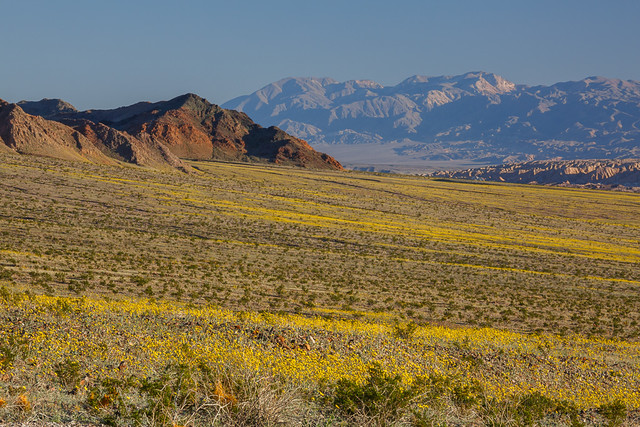
The bloom is definitely moving north and higher in altitude. Although there are still expansive fields of Desert Gold (Geraea canescens) along the Badwater Road, as well as carpets of Sand Verbena (Abronia villosa) from Mile Marker 42 to the end of the road, many of the other flowers in this area are past their peak.

My pick of the week is Highway 190. Look for the cheerful Easter egg colors of bright yellow Golden Evening Primrose (Camissonia brevipes) and purple Notchleaf Phacelia (Phacelia crenulata) from Furnace Creek to the East Park Entrance. There are pink carpets of Purple Mat (Nama demissum) in some sections. (I think this flower was misnamed!) The ethereal, floating blossoms of Gravel Ghost (Atrichoseris platyphylla) are growing thicker in this area than I've ever seen them before. Northwest of the Visitor Center, you will find the expansive fields of Desert Gold that Death Valley is famous for. All along the road, get out and look closer for more variety.

Beatty Cutoff
A nice little loop drive is to go up the Beatty Cutoff Road and down Mud Canyon, then back to Furnace Creek along Highway 190. Mud Canyon is looking fantastic, but the flowers are growing so thick there that there is nowhere to pull over. Use the wide shoulders on the Beatty Cutoff and wander a wash to look for variety.

You will find Phacelia, Golden Evening Primrose, Mohavea (Mohavea breviflora), Acton Encelia (Encelia actoni), and Broad-Flowered Gilia (Gilia latiflora) on the Scotty's Castle Road. Although there are a few flowers on the approaches to Towne Pass and in the Panamint Valley, those areas are not yet worth a special trip. If you have a high clearance vehicle, do a little botanizing in the mid-elevations of the Greenwater Valley to increase your species count. There are not a lot of flowers blooming here yet, but there are a lot of different species, flowers you will not find in the lower elevations.

Hole in the Wall (4WD road)
Best backcountry dirt road drives this week would be the Hole in the Wall Road and Echo Canyon Road. Color and diversity in both these places is fantastic. Titus Canyon has some Paintbrush (Castilleja augustifolia) and Lupine (Lupinus sp.) in the mid-elevations, and flowers are blooming in the lower reaches of the canyon, but it will still be a few weeks before the bloom really gets going here.
For hikers, Fall Canyon and Monarch Canyon are good bets.
Happy flower hunting!

Furnace Creek Wash
February 24, 2016

The bloom is moving North! Check out the great color combo of Golden Evening Primrose (Camissonia brevipes) and Notchleaf Phacelia (Phacelia crenulata) decorating Furnace Creek Wash from the East Entrance to the Furnace Creek Inn. Keep your eyes open in that stretch for expanses of Purple Mat (Nama demissum) and the rounded humps of Turtleback (Psathyrotes ramosissima). Get out of your car and take a stroll in the wash, and you may be amazed at the diversity. I was able to identify over a dozen species in a ten minute walk!

Along Highway 190 north from the Visitor Center to the Scotty's Castle Road, fields of Desert Gold (Geraea canescens) are starting to fill in the blanks. One new hotspot is the Beatty Cut-Off Road. The diversity in some places is nothing short of amazing. Try walking a wash between Mile Markers 2 and 4 to taste a bit of that diversity.If you are traveling to Ubehebe Crater or the Racetrack, the Scotty's Castle Road is adorned with the same gold and purple color scheme as the Furnace Creek Wash. Although there is not enough yet to warrant a special trip, look for expanses of Mohavia (Mohavea breviflora) , blooming Acton Encelia (Encelia actoni), and Broad Flowered Gilia (Gilia latiflora) in this stretch. Phacelia and Golden Evening Primrose are also brightening up the approaches on both sides of Towne Pass.

Badwater Road Mile Marker 30, looking back at 25
The Badwater Road is still the go-to destination for those huge expanses of endless flowers. The Brown-Eyed Evening Primroses (Camissonia claviformis) are starting to bolt due to hot temperatures and lack of rain, but the Desert Gold is still going strong, and the Gravel Ghost Atrichoseis platyphylla), Pebble Pincushion (Chaenactis carphoclinia), and Broad-Leaved Gilia (Aliciella latifolia) are just getting started. If you want those lower elevation flowers, though, you may want to come soon. I am amazed at how quickly the Phacelia and Desert Five Spot ( Erimalche rotundifolia) are working their way up their stems.

Harry Wade Road has some really nice things going on near the Amargosa River Crossing. As usual, get out of your car and walk a wash to see more varieties. Echo Canyon and Hole in the Wall should have some nice flowers. Check out the rock walls and see if you can find Death Valley Monkeyflower (Mimulus rupicola).

Greenwater Valley is REALLY green. Some flowers are starting to bloom there –I saw Fremont Phacelia (Phacelia Fremontii), Desert Dandelion (Malicothrix californica glabrata), Desert Gold Poppy (Eschscholtzia glyptosperma), Checker Fiddleneck (Amsinckia tessellate) , Blazing Star (Mentzelia sp.) and Globemallow ((Sphaeralcea ambigua) –but they are VERY few and far between still. In 2 weeks, this road will really pop.

Dante's View Road uphill from Greenwater Valley... in November!
For hikers, canyons are best for diversity. Fall Canyon is looking great, or try Willow and Sidewinder Canyons, or just wander up a likely wash.

Happy Flower Hunting!

-----

Overall the suggestions were great: accurate and with greater/longer relevance than most visitors may suspect.  By last week the intensity of the bloom had clearly declined down near Ashford Mill from my previous trip in February, but it was 1000X better than a normal year before, so if it had declined to "only" 900X as good, who cares? The opportunities were still tremendous, and well above average for Death Valley.

Alongside Badwater Road, nearly to Jubilee Pass
There's been a lot said about wind last Saturday night damaging the flowers, but again, I suspect that's relative to the mid-February conditions. We're just spoiled this year. I expect that there are plenty of wildflowers left compared to normal, and there will be plenty of exceptional pockets less affected by wind. Also, I bet that certain species such as sand verbena are designed to withstand wind (how the dunes they live in are formed). As I recall, the wind was coming from the south in the evening on Saturday, then from the north the next morning, so many canyons oriented east-west would be protected from that.

Spotted alongside CA-190 north of Furnace Creek
Anyone with a little experience with desert wildflowers and Death Valley should be able to successfully decode the puzzle and find the locations and species best under whatever conditions present themselves. Then again, with so many miles of wildflowers blooming, it's hard to go wrong, and you're bound to do well just driving through the areas highlighted on the Park's wildflower map. I found the scene to the right by the side of the road, simply driving from Furnace Creek to Beatty Junction.  So get out to Death Valley and find whatever compositions catch your eye and imagination!

For more photos, I've started a Death Valley 2016 album on my +Death Valley Workshops page, and a Death Valley iPhone 6S+ Photos album there as well.

Wednesday, February 24, 2016

The Almost Super Bloom in Death Valley

Reports are still coming in strong on the excellent wildflower bloom underway this month in Death Valley National Park. These photos are from my scouting trip through the park February 7-11.  
Desert Gold and Sand Verbena in Death Valley
Desert gold and sand verbena


As of February 9, some flowers were past prime, others were vigorous, others were just emerging.  Some rain fell a week later, which should extend the season for this year's already healthy crop.

Ashford Mill to Jubilee Pass
Looking from the Ashford Mill area toward Jubilee Pass
In spite of the hype in the media and on social media, the park is NOT calling it a "super bloom" yet, but in the recent YouTube video titled "Death Valley Exposed: Wildflowers - February 2016", park ranger Alan Van Valkenburg does imply that it has the potential, perhaps with additional rains: “If you get the chance to see a bloom in Death Valley, especially a super bloom, you should take the opportunity to see it because it could be a once in a lifetime opportunity.”

There was a less dense area of desert gold north of Furnace Creek, up to and through the Beatty Cutoff area. Most other areas were looking basically lifeless, even though they may have received a lot of rain. The timing of the rain may not have been early enough for the plants to be far along yet, and once they get going they do need additional rain to keep the growth going. Rain last week in mid-February might have helped extend the life of these areas, and the growth of others.

Overall the spring wildflowers in Death Valley are usually very sparse, and peak in March, so outside of the areas I just described, the season seemed normal: nothing much should be expected in early February. The initial bloom may or may not be followed by decent blooming elsewhere. We saw healthy growth in November in areas such as the narrow last portion of the Dantes Peak road, so we were expecting the adjacent Greenwater Valley to be going nuts when we returned in February. Instead, it looked even weaker than last year... not much going and much less promising than expected.

So in much of the park, as the initial strong bloom of desert gold fades, the situation may resemble a more normal year, where you can find wildflowers, but it requires some hunting and probably high clearance, if not 4WD.

Here are a few more photographs from my visit to supplement the ones I included in my recent trip report. I drove the park from Dumont Dunes all the way out the top at the town of Big Pine.


Desert gold extensive but thin looking north from the Salt Creek turnoff north of Furnace Creek


Not far from Ashford Mill, south of Badwater


The southern end of Harry Wade Road wasn't as productive as the north end and and the Ashford Mill area.  Many of the flowers were wilted from heat, and didn't look like they were going to last much longer, especially the brown-eyed primrose.


Fiats don't float!  Not in water, not in sand.
Unpaved roads in Death Valley are marked for high clearance or 4WD vehicles for a reason.


It's not all about the desert gold.  Look closely and you'll find dozens of species available.


Bear in mind, the park didn't just suddenly become only about wildflowers!


Miner's cabin