
I arrived in Glacier National Park just in time for sunset over Lake McDonald.


 Along the way, I stopped to do a little fly fishing at the Nature Conservancy's Silver Creek Preserve in Picabo, Idaho. It was a great way to stretch my legs on the long drive.
I'm back in the Tahoe area preparing for my next trip. In addition to Lake tahoe, there are several reservoirs in the area that provide opportunities to catch reflections when you have an interesting sunrise or sunset. This is sunset at Boca Reservoir in the Tahoe National Forest near Truckee, California.
 Sometimes the patterns in the reflections of the sunset are as interesting as the sunset itself.
 Even after the light fades past the point of catching competent landscape images, you can still squeeze in a dimly lit "I am here" shot!
Tucked in the Eastern Sierra near the town of Mammoth Lakes, Convict Lake is a popular fishing destination that makes a fine sunrise or morning shot.
 Trout fishing in the Owens River has gotten much better since the banks were fenced off from grazing cattle.
 Little Hot Creek
Lake Tahoe is 12 miles wide, so even on a dawn that doesn't offer a lot of color you can take expansive wide angle shots or zoom in on a subject to fill more of the frame with what color you do have.
As its name implies, Sunset Bay can be a nice place to catch a sunset, but it gets even better when low tide is close to sunset.
To get a photo sharp from way close to infinity, just focus on the hyperfocal point for your camera, f stop, and degree of zoom (focal length). You can see from the charts here that at f/22 you can reasonably expect to have a photo sharp from least 2 feet to infinity!:
http://www.naturephotographers.net/articles0307/rb0307-1.html
For a link to an Excel spreadsheet you can print showing DOF range for a given camera with various settings:
http://ronbigelow.com/articles/depth-of-field-1/depth-of-field-1.htm
You can fake it by simply pointing your camera at something in the foreground with autofocus on, then after it focuses, switch off the autofocus. Then reframe on what you want to shoot, and let the camera re-acquire a reasonable exposure for that image you want to capture (but it shouldn't destroy the focus you just set).
I've been doing this with DSLRs like Canon XT/XTi/40D, and after I reframe the shot I often hold a graduated neutral density filter in front of the lens and have the camera set on self timer to take 3 exposures (Auto Exposure Bracketing). I simply have to avoid bumping the lens focus manual ring (or I could use masking tape to temporarily keep it set in one place, as I do for night shots once I achieve a good distant focus for star trails).
With a point and shoot camera that doesn't have manual focus, you might have to hold shutter button halfway while you reframe so it holds the close focus point, and you may need to exposure compensate to darken the photo a stop or two so it doesn't emphasize the foreground and overexpose the sky (or just do it on a tripod and take 3 bracketed exposures, which can be averaged in the free trial version of Photomatix).
It's a lot easier than it probably sounds... just focus close, reframe, shoot!
 The effect is most dramatic when you use your widest lens setting, since you can see what's at your feet plus all the way out to the distant horizon. It's even better if you put the camera low to the ground (tripod on its lowest setting) since that emphasizes what's right there at your feet, while including as much as possible out on the horizon and in the distant sky.
I knew the nearly full moon would be setting shortly after sunrise this morning, and the forecast for the coast was for more overcast skies, so last night after Second Beach I headed to Hurricane Ridge in Olympic National Park. The only challenge was the drive after my twilight shots yesterday, putting me in this area at close to 1am for my alarm at 4:15am!
 The flowers were good on the ridge, but they were even better down the access road a few turns.
 I like the results better when I use layers in Photoshop to merge in an adjacent exposure optimixed for the moon rather than using HDR software. More complicated photos may be a different story.
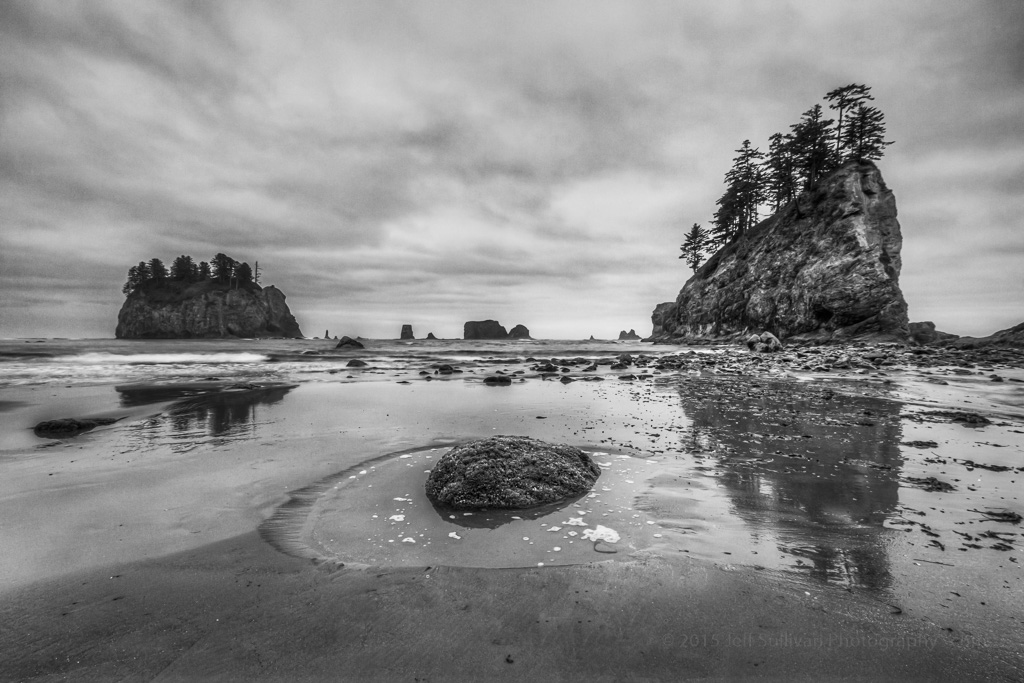
 |
| Sea stack reflection on Second Beach |
The last light of day lights up club moss covering a tree in the Hoh Rain Forest in Olympic National Park, Washington.
 An elk in the rain forest near the town of Queets.
 I need to re-edit this one for white balance (color accuracy), but I like the motion blur...
 The overhanging forest coanopy on the way to Rialto Beach.
for sunset I decided to try Rialto Beach. This site requires only a 20 minute walk, but it's an interesting scramble across a rock breakwater topped with storm debris logs, especially on the way back as it's getting dark!
Ruby Beach in Olympic National Park, Washington.
 A sea stack reflects on the wet sand at Ruby Beach. Even without the colorful sunrise that I had hoped for, it was great to be out before the beach was overrun with visitors, and I still shot about 8GB of photos on this morning!
 More later... I'm off to take more pictures!
To successfully capture great images in a locaiton that you've never visited or haven't visited in a while, a lot much of your success depends on being in the right place at the right time. With dawn color well underway by 5am and sunset running past 9pm, logistical efficiency such as staying in a convenient location plays a role as well. I've been to this park before and I have a good photography guide to the park, but the days I've spent this week will set me up very well to crank out good shots on my next return. Hopefully I'll get some scenic weather!
 This last dawn in Mount Rainier National Park offered the most intersting sky, at least for a few minutes.
 The Paradise Ridge area still has about 10 feet of snow on the ground, but there were patches of flowers in places elsewhere.
The snow it too deep for most of the wildflowers that are normally out by this time of year, but the mountains themselves always make excellent subjects!
 Pikas are small members of the rabbit family that inhabit rocky slopes in subalpine environments.
 Mount Rainier reflected in Reflection Lake.
It isn't necessary for every shot here to have Mt. Rainier in it, but then again, why not?
 Tipsoo Lake with Mt. Rainier in the background.
My photography in Rainier National Park started with some night shot attempts under a moonless sky. I took a few short shots to confirm focus, then left the camera open with the North Star directly over Mt. Rainier. It would have been a great shot if I hadn't fallen asleep and overexposed it! I had to settle for this dawn view a couple of hours later instead.
 Mt. Rainier received 950 inches of snow this last winter, so there's still a snowpack about 10 feet deep in the Paradise Ridge area where there usually are wildflowers by now.
I finished moving out of my apartment a day late, and my legs were cramping from doing the equivalent of several thousand feet of vertical carrying things down from the third floor, but I finally hit the road.
 My first photo stop upon entering Oregon was Silver Falls State Park. I arrived at 6am, too early for the quirky day use opening time of 7am. I stretched my legs with the short hike to North Falls and captured a few images.
  Unfortunately I was still pretty disoriented from the days of packing and driving (and very little sleep), so I completely forgot to shoot the other falls that I intended to visit! No problem, it was a nice park and I'll be happy to revisit the next time I'm passing by.
 My next subject in Oregon was Mt. St. Helens at dawn from Portland. I can sleep when I'm dead. Hopefully that attitude won't bring that about sooner rather than later!
 Taking care of a few more move-out details via a wi-fi connection at a coffee shop, I left Portland with plenty of time to reach the "photowalk" group photo shoot in Seattle. Unfortunately commuters in Tacoma didn't know that I had an appointment to get to, so I arrived late adn missed the group. I did meet soem other attendees that had missed the group, so we had a very nice walk around town anyway.
 This image has been accepted for the art show and competition at the 2008 California State Fair in August and early September. Only a small fraction of works are accepted for inclusion, and I am honored to have my work selected by the judges.


My interest was in my camera, its settings, the composition, the hiking stick in my hand, and the agitated rattlesnake on the far end of it, while keeping it all steady. It was quite a handful, or two hands full!
I put him in some grass out in the sagebrush about 100 yards away from the road. Hopefully he wouldn't head back in that direction, or if he did, it was late at night without the traffic.
You can see how well these snakes blend in with the grass and mixed sun and shade. The babies don't even have working rattles to warn you, which is why it's a good idea to wear boots and not place your hands and feet in places you can't see when travelling in snake country.