Wednesday, June 12, 2013

Milky Way Photography Workshop

Milky Way Reflection and meteor at Topaz Lake on the California/Nevada border, 2013
The best time to view the Milky Way in the Northern Hemisphere is close to the Summer solstice June 21, which is coming up fast. My best workshops for capturing the Milky Way will be June 14 and June 29 in Bodie State Historic Park:
http://activesole.blogspot.com/p/bodie-night-photography-workshops-2013.html

I still have a couple of spaces left in each session. The June 29 date may be the better of the two for Milky Way shots, since The moon rises late, so we'll shoot mostly under a dark starry night sky.  As an added bonus, fellow astrophotographer Steven Christenson will be co-leading this one.  We've both won awards for our photography in the Astronomy Photographer of the Year contest conducted by the Royal Observatory, Greenwich in London (the observatory is home of GMT, Greenwich Mean Time, and all GPS coordinates in the world are defined relative to their site).  June 29 is also the same date as the Google+ 2 year anniversary photowalks, so we may offer a free photowalk in the eastern Sierra earlier that day.  Contact me if you'd like to join us!

Milky Way Reflecting, and Eta Aquarid Meteor?Milky WayStargazing - Winning Image, People and Space CategoryPerseid Meteor Over Bristlecone PineSummer Milky WayMilky Way Over Big Sur
Meteor and Milky Way Over Banner PeakMilky Way Over The Sierra CrestMilky Way Over SoyamajeMilky Way Over Bristlecone PineMilky Way Over Mine RuinsStars Over Star Dust
Arch and StarsAlien TerrainMilky Way Over Mono LakeMilky Way Over Mono Lake Tufa 4Milky Way and Mono Lake Tufa Light PaintingMilky Way and Light Painting Mono Lake Tufa
Other WorldlyMilky Way Over Sawtooth RidgeMeteor and Milky Way over the Sierra NevadaPerseid Meteors over Bristlecone PinesLife From the StarsMeteor Over the Salt Flats
Milky Way, a set on Flickr.

Thursday, June 06, 2013

Bodie Foundation 2014 Calendar, Winning Shot!

Congratulations +Maximilian Laue on your contest-winning shot from our night photography workshop at Bodie last year!
I can't wait to see it on the 2014 Bodie Foundation calendar!

I can't seem to blog your photo provide a URL directly to it, but I can link to my share of it:
https://plus.google.com/104896696773020847048/posts/41fskApuWgE

I'm also thrilled to hear that you can join us again this year, on the dual night/morning sessions Oct 12/13 added today:

June 29th night
August 9th night
August 24 night
Oct 12 night + Oct 13 dawn/interior

Info:
http://www.jeffsullivanphotography.com/blog/bodie-night-photography-workshops/
Registration:
http://www.jeffsullivanphotography.com/blog/
Starry Night Over BodieStar Trails over Bodie ChurchStorm Light at Bodie State Historic ParkGolden Hour at BodieResoluteBroadcasting Knowledge
Sunset and Old Farm TruckGoing Nowhere FastBodie FirehouseBodie ReflectionStorm Threatening No OneBig Wheel
Let There Be Light!Bug EyesBodie Car Black and WhiteOut to PastureOld Cars in BodieBodie Downtown
Standard Mill & Mine, BodieBodie General Store and Stamp MillStandard Mill & Mine InsideBig WheelInside OutsideBodie Days
Bodie State Historic Park, a set on Flickr.

Tuesday, May 28, 2013

Venus, Jupiter, Mercury Conjunction (1080p, 30fps)


The planets Jupiter, Venus and Mercury are close together in the evening sky this week, so every night I've been trying to capture them together on the horizon in the twilight hours before they set. The first night the clouds were too thick. The second night I was shooting sunset in high winds at Mono Lake with the Sierra Nevada as a high western horizon, so I caught a few pictures of the planets, but they set too quickly to capture a time-lapse video. The third night was just right, relatively clear to the west, I was in a high shooting position with an apparent horizon lower than my position (less than 0 degrees elevation), and fortunately that was Sunday May 16, the night when they'd be closest together, forming a tight triangle.

There was still wind to deal with so I changed position a few times to minimize it. I could only use one camera because I had loaned my daughter one of my quick release plates the day before and it was still on her camera back home. There wasn't a lot of light and I was shooting with a 2X teleconverter on my 70-200mm lens at close to 310mm, so my aperture was limited to f/8, forcing me to bump up the ISO to minimize shutter speed in that wind. Fortunately I worked out all the trade-offs in time to capture about four hundred frames, enough to create this time-lapse video. 


Here's how my four days of effort to capture this event turned out:


Pursuing the Venus, Jupiter, Mercury conjunction on May 24, 2013.
May 24 from Lake Tahoe


Pursuing the Venus, Jupiter, Mercury conjunction on May 26, 2013. Too high of a horizon at Mono Lake!
May 25 from Mono Lake

Pursuing the Venus, Jupiter, Mercury conjunction on May 26, 2013, just right with a low horizon.
May 26 from Monitor Pass


Pursuing the Venus, Jupiter, Mercury conjunction on May 27, 2013. Too cloudy over Lake Tahoe!
May 27 from Lake Tahoe

Friday, May 17, 2013

Rainbow in a Sun Ray


Last night I caught a sun ray rainbow, just before sunset, at Topaz Lake on the Nevada/California border.  

You may have noticed that rainbows move as the sun moves.  White light contains all of the colors of the rainbow, and the rainbows we see are simply that light separated out into various wavelengths, which we perceive as colors.  This doesn't happen like it does with a prism, where the rainbow comes out the back side of the prism and that color-separated light is projected onto something.  Instead, raindrops do separate the colors of light through refraction, but instead of it escaping out the back, that light is reflected back out of the raindrop at a 42 to 43 degree angle.  So everywhere you see rainbow color is a raindrop, and if you draw lines back from that rain drop to yourself and to the light source, those lines meet in roughly a 43 degree angle.

Someone standing a mile north of you may see a rainbow, but their rainbow will be coming from a different set of rain drops making a 43 degree angle back to the sun, and their rain drops at that angle will also trace a "rainbow-shaped" arc in the sky.  This is why you can see rainbows while you drive, and they will appear to move and follow you (at that same angle to the sunlight) as you drive.

So as a photographer, if you don't like where the rainbow is, move!  As long as you don't move so much that "your" rainbow doesn't fall off the end of the column of water it's coming from and disappear into dry air, you should be able to place the rainbow where you want it.  Similarly, if you see the sun striking a column of water and the sun seems to be close to the right angle, simply move until you catch that 43 degree angle and can see and photograph the rainbow you anticipated that it was making.

Thursday, March 21, 2013

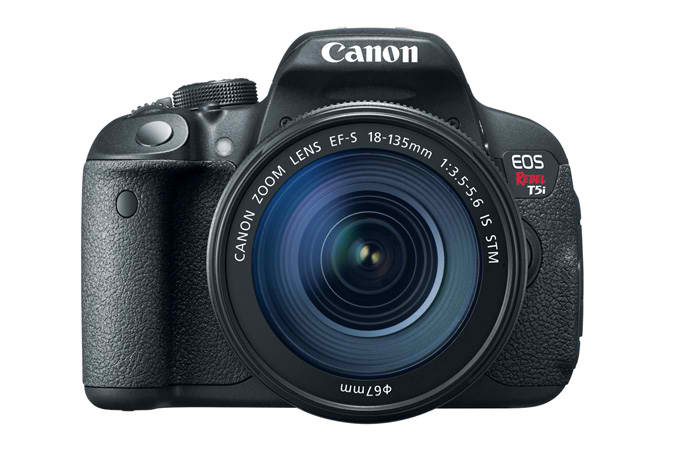
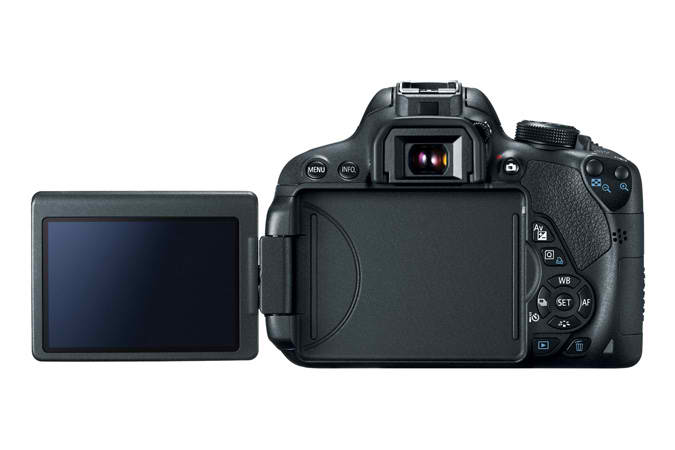
New Canon T5i Camera Pre-order Through Amazon.com

New Canon EOS Rebel T5i Digital SLR Camera Packs Performance With New Creative Controls

MELVILLE, N.Y., March 21, 2013 – Canon U.S.A., Inc., a leader in digital imaging solutions, is proud to introduce a new flagship model to its popular EOS Rebel line, the EOS Rebel T5i Digital SLR Camera. The incredible image quality and performance starts with an 18 megapixel CMOS (APS-C) sensor and Canon's superb DIGIC 5 Image Processor. Combined with an extensive ISO range of 100-12800 (expandable to 25600 in H mode), the EOS Rebel T5i boasts crisp, detailed images, even in low-light conditions. With a continuous shooting speed of up to 5.0 frames per second (fps) united with 9 all cross-type AF focus points, the new EOS Rebel T5i allows photographers the opportunity to shoot with ease, even in challenging shooting situations. When shooting in Live View mode, the Hybrid CMOS AF system enables speedy and accurate autofocus for photos and video. Coupled with Canon's new EF-S 18-55mm f/3.5-5.6 IS STM lens, available in the standard kit lens bundle, the EOS Rebel T5i takes full advantage of the Stepping Motor (STM) technology, which allows the lens to smoothly and silently focus on the subject whether it is moving or standing still. When combined with the camera's high-resolution Vari-angle Touch Screen 3.0-inch Clear View LCD monitor II and intuitive touch controls, the EOS Rebel T5i stands as Canon's most "consumer-friendly" DSLR. "Built to make advanced photography creative and fun, the EOS Rebel T5i Digital SLR Camera gives users exceptional image quality and fast, intuitive operation along with creative functions to help advance photographic expression," said Yuichi Ishizuka, executive vice president and general manager, Imaging Technologies & Communications Group, Canon U.S.A.

Expand Your Creativity with New Advanced Features

The EOS Rebel T5i provides amateur and advanced photographers looking to hone their creative and technical skills with a range of features that allow for crisp, clear images. Whether it is adding saturation to a vivid landscape or applying a unique, vintage touch to a portrait, users who want to express their creativity can experiment with different effects and settings, composing a shot, by using one of Canon's seven Creative Filters. When the Creative Filters are applied in Live View, users can preview the filter on the vari-angle three inch LCD touch screen without having to shoot the image first. Effects such as ArtBold, Water Painting, Grainy Black and White, Soft Focus, Toy Camera, Fish-Eye and Miniature let users pick and choose how to best express their creative vision before or after the image is captured. The EOS Rebel T5i features advanced shooting modes to take creative imaging even further. When using one of the advanced shooting modes such as Handheld Night Scene, HDR Backlight Control or Multi-Shot Noise Reduction, multiple images are taken and combined within the camera to help create the best quality image based off of the shots taken. Providing quick and easy accessibility, a new mode dial with Scene modes has been included, allowing users the flexibility to select the subject matter while the camera determines the optimal settings.

Enhanced EOS Full HD Movie Mode

The EOS Rebel T5i offers easy-to-use professional video capture. When users switch to EOS Full HD Movie mode, the EOS Rebel T5i offers the ability to shoot in 1080p Full HD video in a number of recording sizes and frame rates. With Canon's Hybrid CMOS AF System and Movie Servo AF, the camera provides continuous AF for focus tracking of moving subjects by helping to reduce the camera's need to "hunt", resulting in a quick and smooth continuous AF. While shooting with one of Canon's Stepping Motor (STM) lenses, such as the new EF-S 18-55mm f/3.5-5.6 IS STM lens, the camera will only capture the stereo sound of the scene being recorded. For added flexibility, the EOS Rebel T5i also features a built-in stereo microphone with manual audio level adjustment to enhance sound quality.

Expanded Lineup of STM Lenses

Canon is expanding the lineup of STM lenses by adding one new lens, which now gives users three choices that will allow for the capture of stunning images and video with the EOS Rebel T5i - the EF-S 18-135mm f/3.5-5.6 IS STM, the EF 40mm f/2.8 STM and the new EF-S 18-55mm f/3.5-5.6 IS STM lens. The EF-S 18-55mm f/3.5-5.6 IS STM lens offers high magnification in a compact and lightweight EF-S standard zoom lens with an optical image stabilizer for up to four equivalent stops for shake correction. When paired with the Hybrid CMOS AF, it allows for smooth and quiet, continuous AF for photo and video capturing - making it the perfect combination for preserving those once in a lifetime moments. Availability The EOS Rebel T5i Digital SLR camera is scheduled to be available in April for an estimated retail price of $749.99 for the body alone; $899.99 bundled with an EF-S 18-55mm f/3.5-5.6 IS STM lens kit, and $1,099.00 with the EF-S 18-135mm f/3.5-5.6 IS STM lens kit. The new EF-S 18-55mm f/3.5-5.6 IS STM lens also is also scheduled to be available separately in April at an estimated retail price of $249.99. For more information about the Canon EOS Rebel T5i Digital SLR Camera, the full list of product specifications and compatible lenses, visit www.usa.canon.com/eos.

About Canon U.S.A., Inc.

Canon U.S.A., Inc., is a leading provider of consumer, business-to-business, and industrial digital imaging solutions. With approximately $40 billion in global revenue, its parent company, Canon Inc. (NYSE:CAJ), ranks third overall in U.S. patents registered in 2012† and is one of Fortune Magazine's World’s Most Admired Companies in 2013. In 2012, Canon U.S.A. has received the PCMag.com Readers' Choice Award for Service and Reliability in the digital camera and printer categories for the ninth consecutive year, and for camcorders for the past two years. Canon U.S.A. is committed to the highest level of customer satisfaction and loyalty, providing 100 percent U.S.-based consumer service and support for all of the products it distributes. Canon U.S.A. is dedicated to its Kyosei philosophy of social and environmental responsibility. To keep apprised of the latest news from Canon U.S.A., sign up for the Company's RSS news feed by visiting www.usa.canon.com/rss. ---

Product Features

Style: Canon T5i with 18-135mm EF-S IS II Lens
  • 18.0 Megapixel CMOS (APS-C) sensor, 14-bit A/D conversion, ISO 100-12800 (expandable to H: 25600) for shooting from bright to dim light and high performance DIGIC 5 Image Processor for exceptional image quality and speed.
  • 9-point all cross-type AF system (including a high-precision dual-cross f/2.8 center point) for exceptional autofocus performance when shooting with the viewfinder and Hybrid CMOS AF increases autofocus speed when shooting photos and movies in Live View.
  • High speed continuous shooting up to 5.0 fps allows you to capture all the action.
  • EOS Full HD Movie mode with Movie Servo AF for continuous focus tracking of moving subjects, manual exposure control and multiple frame rates (1080: 30p (29.97) / 24p (23.976) / 25p, 720: 60p (59.94) / 50p, 480: 30p (29.97) / 25p), built-in stereo microphone, manual audio level adjustment, and Video Snapshot with editing for expanded movie shooting options.
  • Vari-angle Touch Screen 3.0-inch Clear View LCD monitor II (approximately 1,040,000 dots) with smudge-resistant coating features multi-touch operation and Touch AF for an easy and intuitive experience, flexible positioning, and clear viewing even when outdoors.
Shipments begin April 30:

$749.99 for the body alone: http://www.amazon.com/gp/product/B00BW6LW7G?ie=UTF8&creativeASIN=B00BW6LW7G&tag=jeffsulliphot-20

$899.99 bundled with an EF-S 18-55mm f/3.5-5.6 IS STM lens kit: http://astore.amazon.com/jeffsulliphot-20/detail/B00BW6LWO4

$1,099.00 with the EF-S 18-135mm f/3.5-5.6 IS STM lens kit: http://www.amazon.com/gp/product/B00BW6LX20?ie=UTF8&creativeASIN=B00BW6LX20&tag=jeffsulliphot-20

Monday, March 11, 2013

Full Moon Rise at Mono Lake in January

When I arrived to shoot the full moon rise over Mono Lake in January, there were 4-5 carloads of photographers capturing the sunset, but none of them were there for the moon rise.  Having planned the shot in advance using +The Photographer's Ephemeris (TPE), I told them to stick around for another 10 minutes. 
It was fun hanging out with +Amy Heiden +Tran Mai and +Lori Hibbett in the Mono Basin for the day.  There was fog on the lake all the way through 3 pm, but fortunately it cleared just in time for the moon rise.  When we arrived at the Old Marina site +Blair Pountney joined us.  He had seen my notes on the coming moon rise last week and drove up from Bishop.  Then we ran into +Travis Theune and +Schmoo Theune of Smugmug, so we had a fun little group of photographers gathered, from various parts of the state!

I captured about 400 images, enough for this time-lapse video.  I had problems with a light tripod in the intermittent gusty wind which developed, so the result is pretty funny.  After the moon rise, Amy, Tran, Lori and I went on to shoot into the night by the light of the full moon, so check their streams in the coming days for night snowy landscape shots. I decided that meeting Travis and Schmoo was a great reminder to update my Mono Lake gallery on +SmugMug (I'm not as diligent about that as I should be), so if you're curious to see more of my work from Mono Lake, here's the link to that gallery, where you can see a larger copy of this image.

Mono Lake moon rise January 2013.  See a larger copy (or buy prints) on SmugMug.

If you'd like to plan your own sunset full moon rise shots, here's my blog post on planning to shoot sunset moon rise events using TPE:

Put Sunset Full Moon Rise Dates on your Calendar
http://www.jeffsullivanphotography.com/blog/2010/12/09/put-sunset-full-moon-rise-dates-on-your-2011-calendar/

Here's one of my blog posts on creating time-lapse videos:

Create a Timelapse Video on Your Digital Camera

http://www.jeffsullivanphotography.com/blog/2011/08/01/create-a-timelapse-video-on-your-digital-camera/

Thanks to astronomer +Philip Plait for blogging about my moon rise coverage on his +Bad Astronomy blog on +Slate magazine.  He provides a nice diagram explaining this "Belt of Venus" pink over blue light that you get at Mono lake after sunset: Moon Rise over an Arsenic Lake.

In the past he featured the sunset thunderstorm I caught in early 2012, as well as my lunar eclipse timelapse video on his Bad Astronomy blog on +Discover Magazine.

He also featured the Perseid meteor shower in 2008 shot in California's Ancient Bristlecone Pine Forest:

The Perseids, Writ Large
http://blogs.discovermagazine.com/badastronomy/2009/08/25/perseids-writ-large/


Google+: Reshared 111 times Google+: View post on Google+

Friday, March 08, 2013

Space Available for our Death Valley Workshop Next Week!


Enrollment for our Spring in Death Valley landscape photography workshop is coming along well.  We have several photographers enrolled.  My friend Bill Wight is joining us as a third instructor, so I think it'd be hard for photgoraphers to find a better student to teacher ratio!  Bill will be joining us for an Eastern Sierra workshop in June as well.

Next week we'll have not only Spring wildflowers to shoot in Death Valley's exotic landscapes, we'll also be able to pursue shots of comet PANSTARRS, a crescent moon set, then enjoy dark skies for star trails and light painting shots.  I like to schedule dates when we can maximize our photographic opportunities!

I put together an album of shots from my 2006 - 2008 visits over on my +Death Valley Workshops page on G+, and I visited the park at least 8 times in that timeframe alone.  In 2010, 2011, 2012 and now in 2013 I've been intentionally exploring the vast reaches of America's largest national park in the lower 48 states for my upcoming book, so my knowledge of Death Valley's secrets has grown by leaps and bounds.  Workshops aren't just for photography instruction; on-the-ground experience is a key value to deliver as well.  You can hit the same old tired viewpoints in the same way as the park's 1 million other visitors, or I can show you fresh perspectives and unique spots.

If you can't join us for next week's visit to Death Valley, no problem, we'll announce at least one more trip later in the year.  We'll also have workshops in Yosemite, the Eastern Sierra, and like last year, night workshops at Bodie State Historic Park.  Contact me for details and notification as they're announced.

Rainbow in Bridalveil Fall, Yosemite Valley, Yosemite National Park.  I was there to catch the moon rise from behind Half Dome... it came up just a few minutes later!

Tuesday, January 29, 2013

Moon Jupiter Conjunction


Moon-Jupiter Conjunction, January 2013 (1000mm, 1080p, 15fps) from Jeff Sullivan on Vimeo.

I looked outside the other night and saw a bright object next to the moon.  Sky at Night Magazine had predicted that there would be a Moon and Jupiter conjunction on January 22, and I realized that it was about 6 am Uninversal Time on the 22nd.  I've taken photos of Jupiter at 400mm before, and those images can crop down to an effective 1000mm or so with no loss of resolution, so I set my camera outside to fire off a few hundred frames.

I had the intervalometer set to capture one frame every 3 seconds, and at that focal length and crop Jupiter only stays in a 16 x 9 HD-shaped frame for 210 shots, so I get either 7 seconds at 30 frames per second or 14 seconds at 15 frames per seconds.  The movement seemed a little less jerky at the slower frame rate, so that's what I've uploaded.  The movement could probably be smoothed out by taking the 30fps version and using software to simulate slow motion and inserting intermediate frames which track the movement of the moon and Jupiter... some day when I have all the time in the world, and the ultimate post-processing suite to go with it!